
APIs and integrations that stay up when the business depends on them
Custom API development is the work of making CRM, billing, inventory, and internal tools share one version of the truth. API development services here means production contracts, not a Zap that silently dies on Friday.
Looking for a custom API development company in the USA usually means Zapier glue and CSV exports already failed you. I design and ship those APIs and integrations from Seattle: REST and GraphQL, third-party SaaS wiring, and hardened sync for finance, ops, and customer portals. Solo senior engineer. US-based. Nationwide clients. Seattle API work is in-person when it helps; the same stack ships nationally.
A custom API development company in the USA
Seattle.dev is not an offshore bench with a US sales office. You work with me. Pacific hours, production-grade integrations, docs a later hire can maintain.
Who this is for
Teams drowning in duplicate entry: sales updates the CRM, ops retypes into a warehouse tool.
Companies whose marketplace "connectors" miss fields or fail weekly.
Product owners who need a stable partner or customer API others can call safely.
Portal and automation fronts that need a real backend contract. See custom web portals.
Who this is not for
A one-off script nobody will maintain. If a scheduled export truly is enough, keep it and spend the money elsewhere.
Buyers who want the integration to "just work" without naming a system of record or an owner for failures.
Greenfield public API products with no consumers. Build the product path first; version the API when someone needs it.
What I build
System-to-system sync. CRM ↔ accounting, e-commerce ↔ inventory, support ↔ product data.
Public or partner APIs. Versioned endpoints, keys or OAuth, rate limits, docs partners trust.
Event-driven flows. Webhooks, queues, idempotent handlers so double-posts do not double-charge.
Middleware for messy stacks. Normalize legacy databases and modern SaaS without a big-bang rewrite.
Deep platform work. HubSpot, Twilio, payments, commerce when toggling a connector is not enough.
Systems I connect
Custom API integration is usually these stacks, plus the awkward internal database nobody documented:
- CRM: HubSpot, and the custom objects native apps will not map.
- Comms: Twilio SMS/voice with CRM context, not blast marketing.
- Payments and commerce: Stripe, PayPal, Shopify, Amazon order/product sync.
- Accounting: QuickBooks and similar ledgers so invoices stop living in a spreadsheet.
- Ops and data: inventory, PostgreSQL, warehouses, partner APIs.
- Portals: the logged-in front door that consumes the API. See custom web portals.
If the job is “connect HubSpot to X,” start on the HubSpot integration page. The plumbing is still custom API development.
Custom API vs Zapier or a native connector
Use a native connector or Zapier when two apps, few fields, and a missed sync is annoying, not expensive.
Use custom API development and integration when you need:
- A system of record and conflict rules (who wins when HubSpot and accounting disagree)
- Retries, alerts, and an owner at 2 a.m.
- Volume, custom objects, or fields the marketplace app ignores
- A partner or customer API others can call safely
I will tell you if a connector is enough. That is cheaper for both of us.
How engagement works
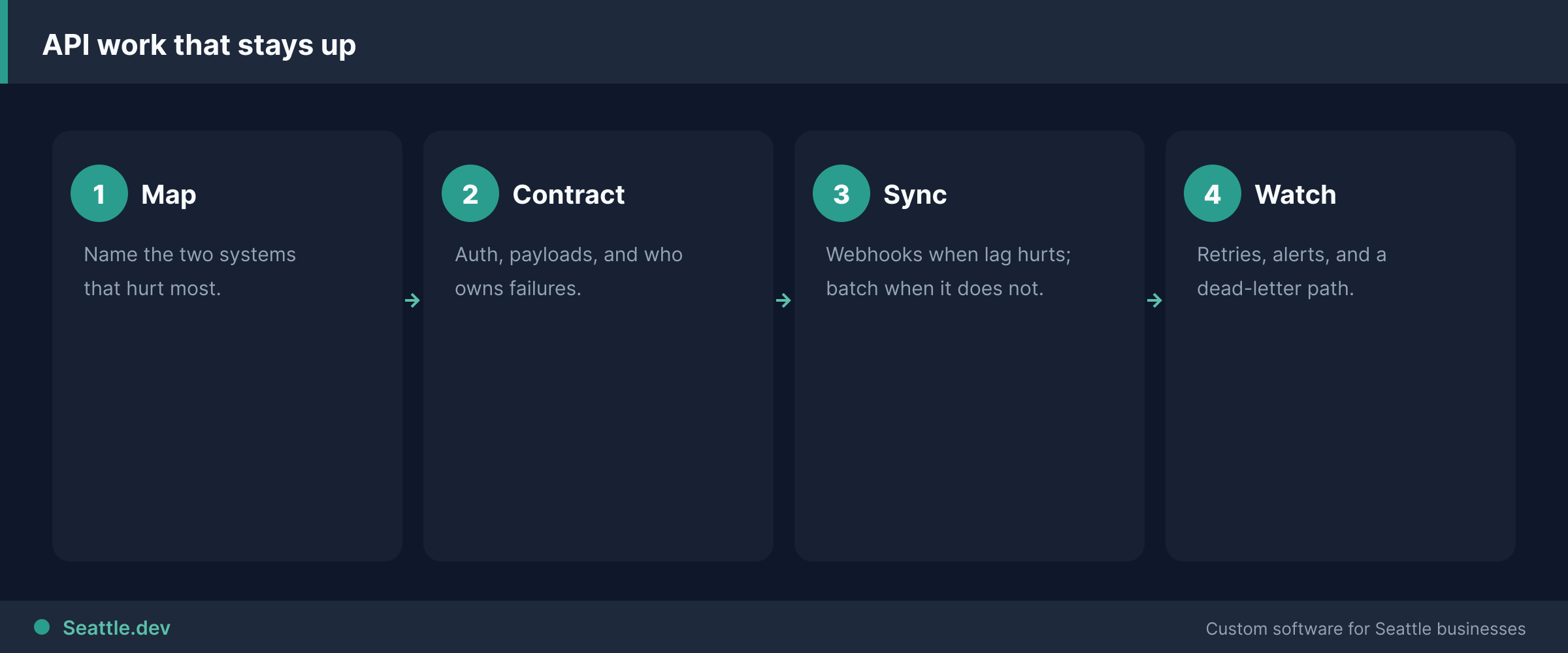
- Map systems and pain: which handoff costs the most time, money, or risk?
- Choose the contract: new API vs. vendor integration; real-time vs. batch.
- Build a thin vertical: one critical path live, failures handled.
- Harden: logging, alerts, retries, docs, runbooks.
- Expand only after the first connection is boringly reliable.
Related: enterprise integration, workflow automation. Ops story: eliminate duplicate data entry. When the API is feeding live screens, integrating your dashboard with business tools covers the UI side of the same problem.
How much does it cost to build a custom API?
| Scope | Typical range | Typical timeline |
|---|---|---|
| Focused two-system integration | Lower five figures | 2–6 weeks |
| Multi-system or partner API | $30,000–$100,000+ | Phased; first path live early |
| Portal plus API platform | Same band as portal work | 8–16 weeks |
Driven by system count, auth complexity, and real-time vs batch. Documented handoff or ongoing support so the integration does not become orphaned tribal knowledge. Switching systems without losing history is its own discipline: data migration strategies for switching systems.
Bring the two systems that hurt most. I will map the fix and a realistic range.