
Enterprise integration without the theater
"Enterprise integration" gets sold as a multi-year program with a room full of architects. Most mid-size companies need something sharper: the systems that run revenue and operations talking to each other reliably, with clear ownership when something fails at 4 PM on a Thursday.
I plan and build those integrations: APIs, middleware, data sync, and the operational glue between CRM, ERP, finance, support, and custom apps. Seattle-based, senior, hands-on. Twenty-seven years shipping production software, not slideware.
Who this is for
Companies with several systems of record that disagree about customers, orders, or inventory. Moving between systems without losing history is covered in data migration strategies for switching systems.
Teams past the point where point-to-point Zapier links can be reasoned about or trusted. When the pain is pure re-entry, the pattern is the same as eliminating duplicate data entry with API integration.
Operators launching a portal or automation layer that needs trustworthy data underneath.
Leaders who want monitoring and runbooks, not "ask Dave, he knows the FTP."
Who this is not for
A single SaaS-to-SaaS toggle that already works. Do not hire me to feel enterprise.
Rip-and-replace ERP programs where the vendor's SI army is the real engagement. I can advise on edges; I am not a 50-person cutover firm.
Buyers who will not fund error handling, retries, and observability. Happy-path-only integrations fail in production, usually during your busiest week.
What the work looks like
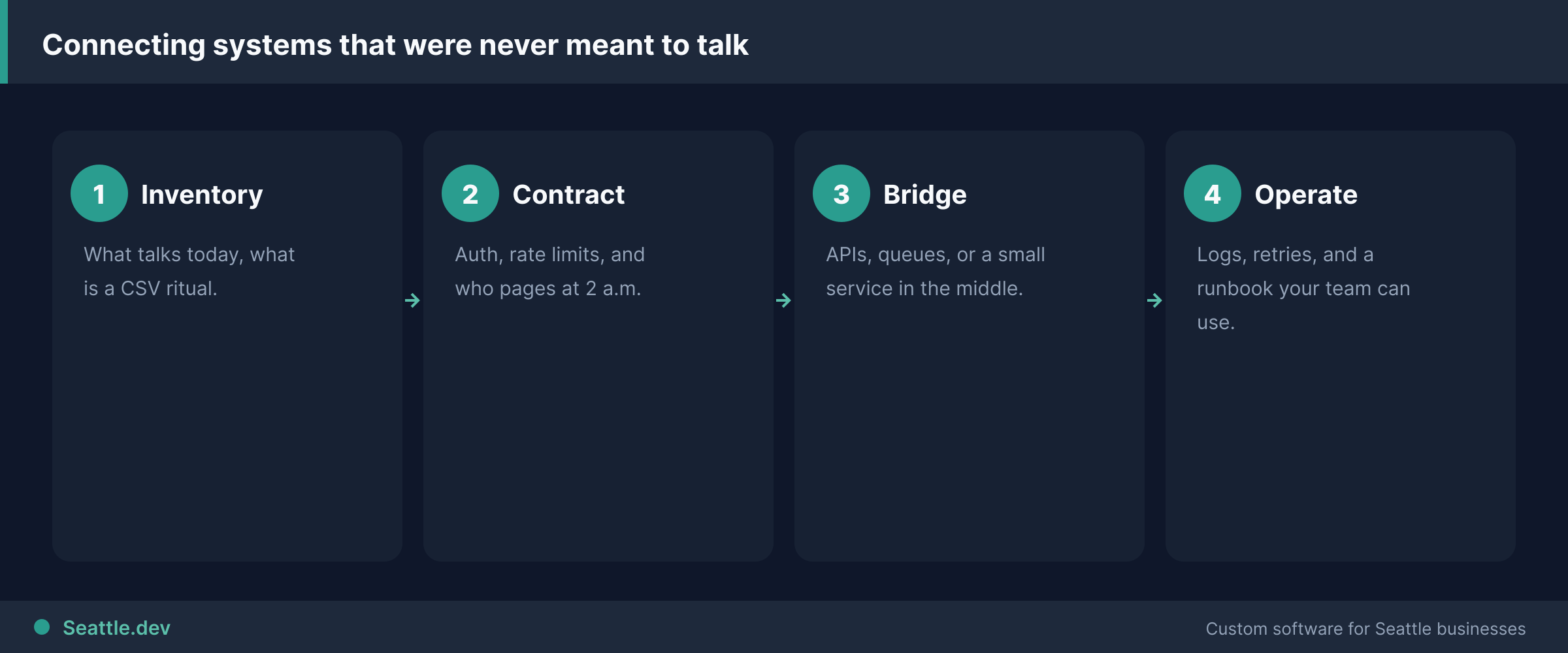
Map before build. Inventory systems, auth methods, data ownership, and the handoffs that hurt. If nobody can name the system of record for "customer," I fix that in writing before code.
Choose patterns deliberately. REST/GraphQL, webhooks, queues, batch files, or database read paths. Least complex option that meets latency and reliability needs. Details live under API development. When integrations feed leadership screens, see integrating your dashboard with business tools.
Normalize and protect. Transformation, validation, idempotency, credential hygiene. No API keys in spreadsheets.
Operate. Logging, alerts, and docs so your team is not trapped when I am on vacation.
Deep platform examples: HubSpot, Twilio, payments, commerce. Process automation that sits on top of clean integrations: workflow automation.
Cost and timeline
Integration cost tracks system count and messiness more than buzzwords. Focused two- or three-system work often sits in the lower-to-mid five figures over a few weeks. Broader programs phase like other custom software in the $30K–$150K band with 30/40/30 milestones when scoped as a full project. Fixed-price once scope is real; uncertainty gets a paid discovery phase, not a guess dressed as a bid.
Hosting and ops for integration middleware usually folds into your existing cloud bill or a managed hosting setup. Ongoing support from about $750/month if you want someone accountable when a vendor changes their API without warning.
Next step
Schedule a consultation. Bring the systems list and the weekly fire. I will say what to connect first, what to leave alone, and what it should cost to make the first path boringly reliable.