
HubSpot that talks to the rest of your stack
HubSpot is fine software. Most of the pain I see is not HubSpot itself. It is HubSpot living alone while orders sit in Shopify, invoices live in QuickBooks, and someone retypes the same customer into three places before lunch.
I connect HubSpot to the systems you already run so the CRM is a system of record, not a graveyard of half-updated contacts. The goal matches eliminating duplicate data entry between business systems.
Who this is for
Teams on HubSpot Professional or Enterprise that outgrew native connectors and Zapier glue. When the CRM has to feed live ops screens, see integrating your dashboard with business tools.
Sales and marketing ops people who need custom objects, workflows, and reporting that mix CRM data with e-commerce, finance, or internal tools. Larger process maps live under workflow automation that reduces manual work.
Companies that want a HubSpot CMS site or HubDB-backed tools without hiring a full HubSpot agency bench.
Who this is not for
"We just bought Starter and need someone to set up email templates." That is configuration, not custom integration. Use HubSpot's academy or a cheap admin contractor.
Companies that refuse to clean their data. Bad CRM data integrated faster is still bad CRM data. I will say so before I build sync jobs that amplify the mess.
Anyone who needs a full custom CRM. If HubSpot cannot model your process without heroic contortions, look at custom CRM development instead of more middleware.
What I build
Two-way sync with real systems. E-commerce orders and products, accounting invoices and payments, support tickets, and internal apps. Fields map deliberately; conflicts have rules.
Workflows that span tools. A closed-won deal that creates a project, a failed payment that notifies ops, an onboarding sequence that only fires when the warehouse confirms.
Custom reporting. HubSpot data next to numbers from systems HubSpot never sees, so leadership stops pasting CSV into Excel every Monday.
HubDB and CMS work. Structured content, calculators, and partner tools on HubSpot when that is the right delivery surface.
Training for the people who live in it. Docs and a short working session so your team owns day-to-day changes.
Broader plumbing beyond HubSpot: API development.
HubSpot systems I connect
Google already sends hubspot + other tool queries here. I do not ship a thin page per connector. I do ship custom HubSpot integration services for the stacks that show up in real projects:
Project and delivery. Teamwork after a deal closes. Smartsheet when the delivery plan lives in sheets.
Commerce. Amazon seller/order data, PayPal payments, Shopify when the native app drops line items or refunds.
Cloud and data. AWS jobs, Redshift or PostgreSQL warehouses so reporting is not a Monday CSV ritual.
ERP and finance. Business Central, SAP S/4HANA, accounting tools. Native finance apps are fine until invoices, tax, or custom objects disagree with HubSpot.
Comms and ops. 3CX, Mailjet, Cyfe-style dashboards, Zendesk via the same API layer.
Automation platforms. Make / Integromat is fine until branching, volume, or permissions need real software. Then it becomes custom API development.
Each cell is the same decision: native app if it maps; custom API if it does not. Read custom vs native HubSpot integrations.
Custom vs native HubSpot integrations
HubSpot’s marketplace is the right first stop. Custom work starts when:
- Custom objects or properties the app ignores
- Two-way sync with conflict rules
- An ERP, warehouse, or internal database HubSpot never sees
- A portal that must show live CRM state
- The native app “works” but staff still retype the exception cases
If a marketplace app plus a cleanup sprint will do, I will say so and not invent a project.
How HubSpot integration services run
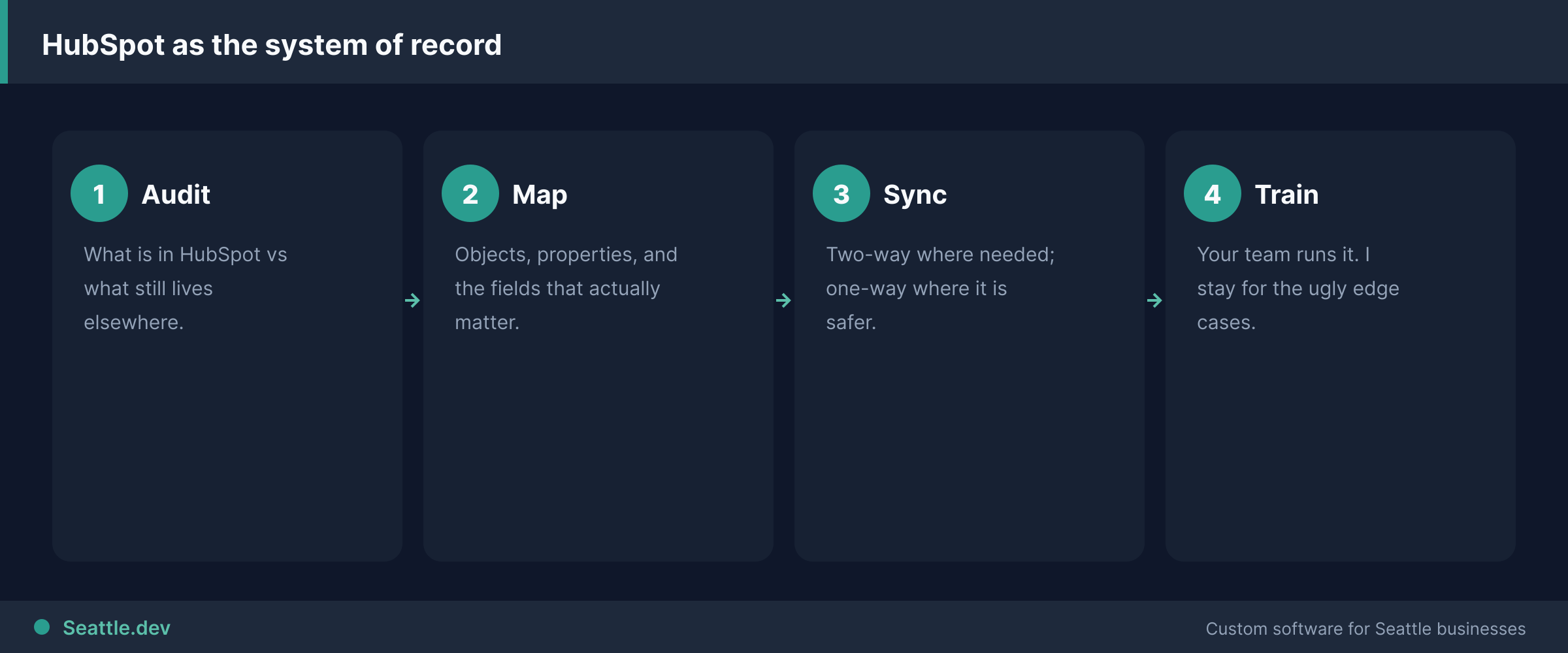
- Discovery and audit. Objects, properties, system of record, who owns bad data.
- Field map and sync rules. Direction, conflicts, real-time vs batch.
- Build or configure. Marketplace app where it fits; custom API where it does not.
- QA in sandbox. Then a controlled cutover, not a Friday surprise.
- Launch, train, monitor. Alerts when sync fails; your team owns day-to-day HubSpot.
Cost and timeline
| Scope | Typical range | Typical timeline |
|---|---|---|
| Focused two-system HubSpot sync | Low-to-mid five figures | 2–6 weeks |
| Multi-system or portal plus CRM | $30,000–$100,000 | Phased |
| Native-app configuration only | Usually not a custom project | I will point you to HubSpot or an admin |
Bring which objects matter and which system is the source of truth. I will map what HubSpot should own, what it should only display, and what it should not try to do at all.