


Seattle Dev

AI Integration Services

Wire ChatGPT, Claude, and other models into the systems you already run. Practical AI features with logging, fallbacks, and a clear job to do.
Two colleagues reviewing AI-assisted writing on a laptop in a bright office

Put the model on a job someone already hates copying.

How we start

Connect, write a plan, then stay in the work

You are not hiring a vendor who vanishes after a kickoff. You get us as an embedded partner who learns the business, then ships against the plan.

01

Connect

Thirty minutes. We learn how the business actually runs: who buys, what is broken, what a good month looks like after launch.

02

Write a plan

What to build, what to skip, an honest range, and whether we are the right fit. You leave with a path, not a pitch deck.

03

Embed

You work with the people who ship it. We stay in the work after launch so the site does not rot the week after deploy.

AI Features That Earn Their Keep

Intelligent tools inside your stack: productivity gains you can measure, not a science project.

Conversational AI Integration

Chatbots and assistants on ChatGPT, Claude, and other LLMs, with escalation when confidence drops.

Document Processing & Analysis

Extract, summarize, classify, and route invoices, contracts, and forms so staff stop retyping PDFs.

Personalization Engines

Recommendations and tailored experiences from real user behavior, scoped to what improves conversion or retention.

Predictive Analytics

Forecasts and opportunity flags from your data when the model beats a simple report.

Computer Vision Solutions

Image and video analysis for objects, text, and patterns when visual input is the bottleneck.

Custom AI Model Development

Task-specific models and prompts on your data when off-the-shelf APIs are not enough.

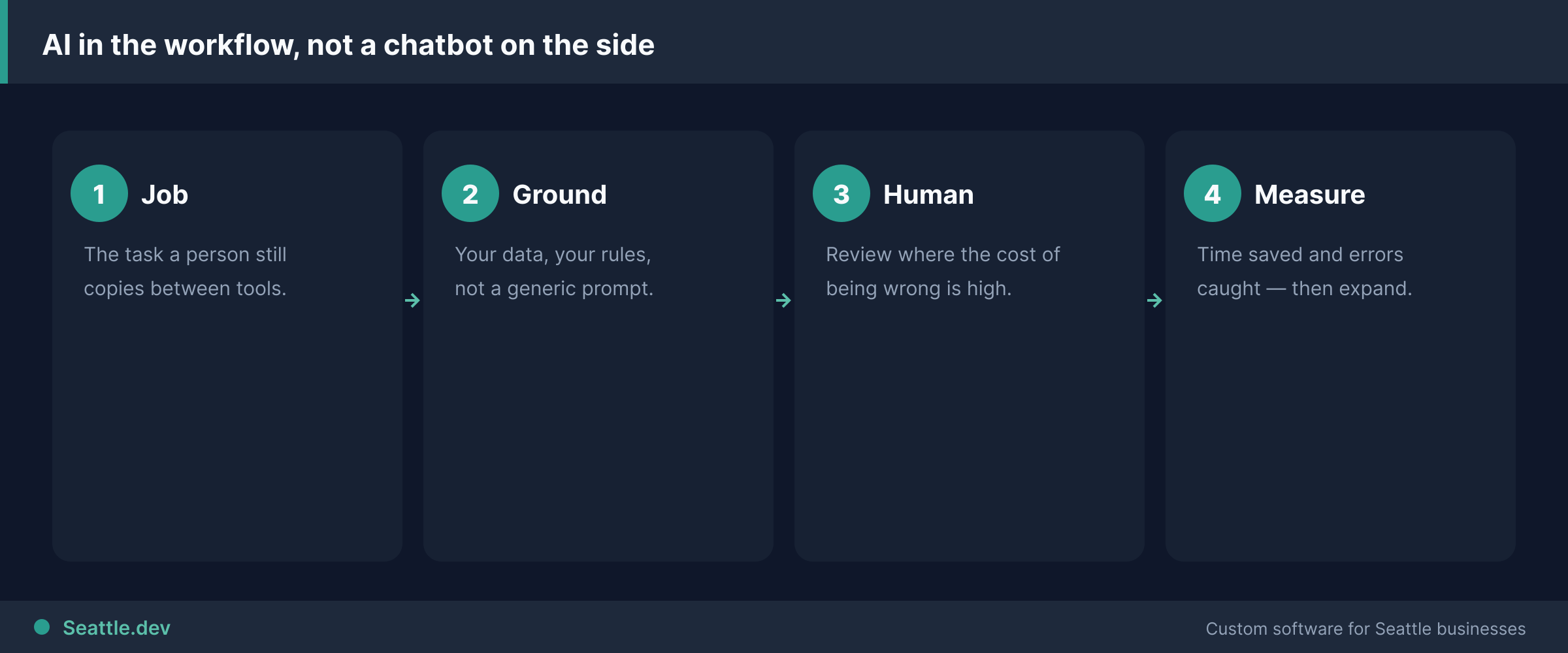
AI integration process
Ground it in your data. Keep a human where being wrong is expensive.

AI that does real work in your systems

Most AI demos die on contact with a real business. The model answers a chat window. Your team still copies the result into HubSpot by hand. I build the other kind of AI: wired into the tools you already run, with logging, fallbacks, and a clear job to do.

If you want a research lab or a six-month "AI transformation program," this is not me. If you want ChatGPT or Claude extracting invoices, triaging tickets, or drafting inside a portal your staff already use, that is the work.

Who this is for

Ops and support teams drowning in PDFs, email threads, and form submissions that follow a pattern a model can handle.

Product and portal owners who need one intelligent feature, not a new company org chart.

Teams mid-experiment who tried a plugin chatbot, got noisy answers, and need reliability before customers or staff trust it.

Who this is not for

Companies shopping for "an AI strategy deck." I ship software.

Regulated bets that need a dedicated ML research staff and multi-year model training. Buy a specialized vendor or hire full-time specialists.

Anyone who wants AI instead of fixing a broken process. Automating chaos just makes chaos faster. Fix the workflow first; then add models where they save real hours. For the non-AI side of that cleanup, see how workflow automation reduces manual work.

What I actually integrate

Support and chat that escalate. Bots for common questions, with confidence thresholds and a path to a human. No black hole of fake helpfulness.

Document processing. Pull fields from invoices, applications, contracts, and forms. Summarize, classify, route. Your team stops retyping what the PDF already said.

CRM and portal helpers. Draft replies, suggest next steps, score leads, surface account context inside HubSpot or a custom portal. See also HubSpot integration.

Search that understands intent. Semantic search over your docs and knowledge base when keyword search fails.

Workflow steps, not magic. Pair models with rules and human review. Larger process work lives under workflow automation. When the real pain is still spreadsheet re-entry, start with when spreadsheets become a business liability.

How I work (and what it costs)

I start with the expensive problem: hours wasted, tickets stuck, revenue friction. Then a thin proof of concept in about 1–3 weeks so you can judge quality before a full build. Production means auth, logging, rate limits, cost controls, and a fallback when the model is wrong.

AI features for SMBs usually sit inside a broader project in the same ranges I publish for portals and software: often a slice of a $30K–$100K build, not a separate "AI tax." API usage (OpenAI, Anthropic, and the rest) is billed on your accounts so you see spend. For how those project numbers break down in practice, read understanding custom software costs.

Local, hands-on AI consulting with Pacific-hours support is the sister page: AI Specialist Seattle.

Next step

Bring the messy workflow and the systems it touches. Schedule a consultation. I will tell you whether a model earns its keep, what off-the-shelf already covers, and what a fixed-price slice should cost.

Talk to an expert

One feature that finishes a job, not a chatbot demo

Free 30-minute call. We pick one workflow a model can actually complete, with logging and a fallback.

We take on a small number of new builds at a time so every project gets focused attention.

Prefer a range first? Run the 2-minute cost estimator .

FAQs

What does custom AI integration actually include?

I wire models like ChatGPT or Claude into the systems you already run: document extraction, support triage, CRM helpers, and workflow steps with logging and fallbacks. The goal is a job the model can finish or hand off cleanly, not a chat demo that dies when staff leave the tab.

How much does AI integration cost?

AI features for SMBs usually sit inside a broader portal or software project in the same ranges I publish elsewhere: often a slice of a $30,000–$100,000 build rather than a separate AI tax. Model API usage (OpenAI, Anthropic, and the rest) bills on your accounts so you see spend. I start with a thin proof of concept, typically about 1–3 weeks, before a full production slice.

How long until we see something working?

A focused proof of concept is often ready in 1–3 weeks so you can judge quality before committing to production hardening. Full production (auth, logging, rate limits, cost controls, fallbacks) depends on how many systems we touch and follows the same phased delivery I use for portals and APIs.

Do I need custom AI if ChatGPT already works for my team?

If people paste into a chat window and that is enough, you do not need custom integration. Hire this when the result has to land in HubSpot, a portal, a ticket queue, or a document store without retyping, and when you need audit trails and a path when the model is wrong.

Talk to an expert

One feature that finishes a job, not a chatbot demo

Free 30-minute call. We pick one workflow a model can actually complete, with logging and a fallback.

We take on a small number of new builds at a time so every project gets focused attention.

Prefer a range first? Run the 2-minute cost estimator .

Seattle.dev Footer Background
Seattle Dev

Custom web development and design for Seattle businesses. We specialize in API integration, custom web portals, and business automation.