Text and voice that customers actually notice
Customers answer text messages. They ignore emails, let calls go to voicemail, and swipe away push notifications, but texts get read within minutes. That is why Twilio integration is one of the highest-leverage additions to a business system: appointment reminders that prevent no-shows, order and dispatch updates people welcome, verification codes that secure accounts, and support conversations that meet people where they already are.
I build Twilio into the systems you run so communication is a feature of the operation, not another dashboard somebody forgets to check.
Who this is for
Service businesses bleeding money on no-shows and missed updates.
Ops teams dispatching field staff who live on their phones.
Products that need solid phone verification or 2FA without inventing crypto.
Companies ready to connect messaging to CRM, scheduling, or order systems so every text has context. That is the same integration mindset as eliminating duplicate data entry between systems.
Who this is not for
Bulk spam and purchased lists. I will not help you burn a number's reputation or your brand.
"Just send texts from a spreadsheet" with no opt-in trail. Compliance is not optional polish.
Teams that will not own carrier registration and opt-out handling. Without that, deliverability dies.
Twilio integration use cases
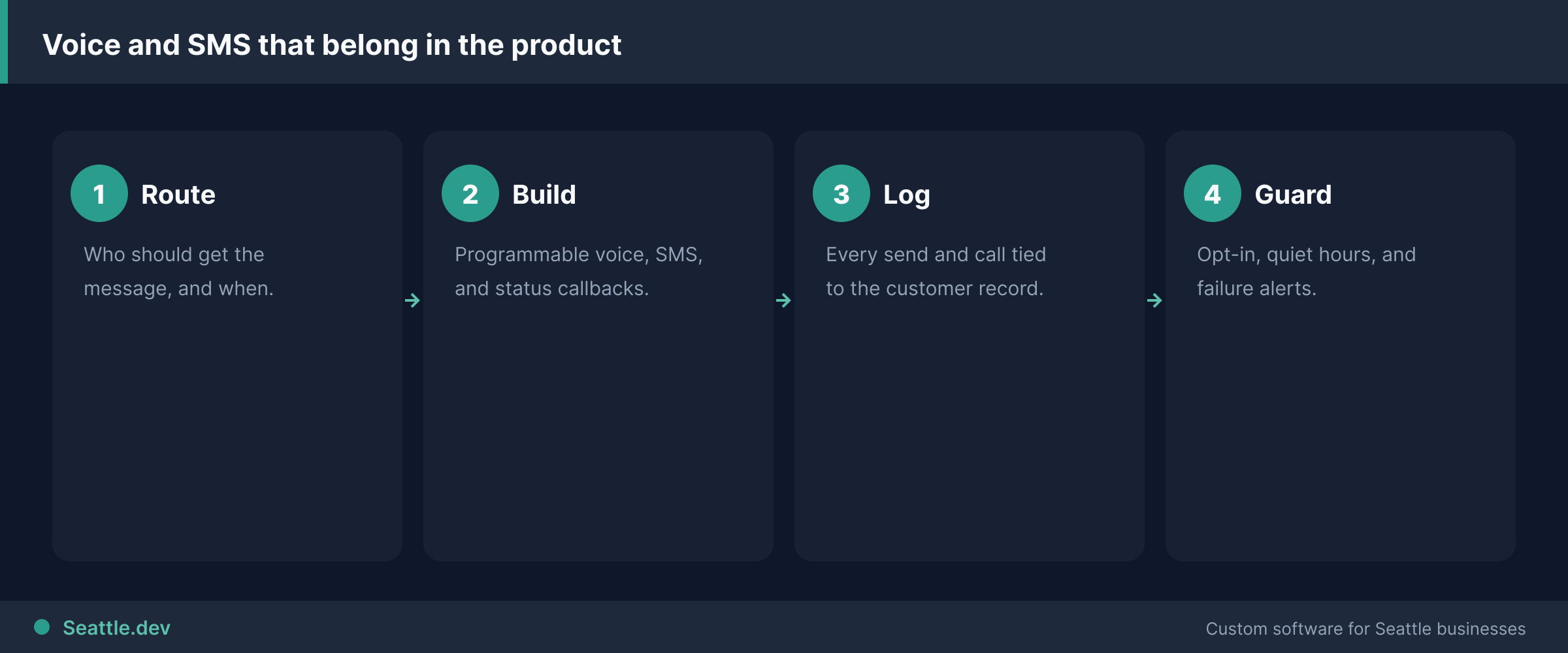
SMS that earns its place. Reminders, delivery and dispatch notifications, status updates, review requests, triggered by events in scheduling, CRM, or orders. Status surfaces for staff often look like the patterns in integrating your dashboard with business tools.
Voice and IVR. Click-to-call from a portal, call tracking and recording, menus that route without a human switchboard.
Verification. Twilio Verify for 2FA and phone checks so you do not maintain your own stack.
WhatsApp and chat channels when that is how customers prefer to reach you, logged back to the customer record.
Glue to your systems. CRM, help desk, scheduling. Broader plumbing: API development.
Systems Twilio talks to
HubSpot. Appointment and deal-stage texts with the contact record, not a CSV of numbers. Pairs with HubSpot integration.
Zendesk. SMS and voice that open or update tickets so support is not bouncing between inboxes.
Scheduling and orders. Reminders, dispatch, delivery windows. The message fires from the event, not from someone remembering to text.
Portals. Click-to-call or in-app verification on a custom web portal.
If customers miss appointments, you are already paying for this integration in no-show revenue. That cost of waiting is the urgency, not a countdown timer on my calendar.
The honest parts
Carrier registration is real work. US business texting needs A2P 10DLC registration. Skip it and messages land in spam. I handle brand and campaign registration as part of the build.
Twilio bills by usage. Per-message and per-minute fees sit on your Twilio account. Modest at small-business volumes; I model them up front.
Compliance matters. Opt-in, opt-out, quiet hours. That keeps number reputation clean and messaging legal.
Twilio integration services cost
| Scope | Typical range | Typical timeline |
|---|---|---|
| One high-value SMS or voice flow | Low-to-mid five figures | 2–6 weeks |
| IVR, two-way messaging, CRM sync | Higher five figures | Longer, phased |
| Slice of a portal or automation project | Inside the $30K–$100K band | With that project |
Twilio usage (messages, minutes) bills on your Twilio account. I model that up front. Process automation around those messages: workflow automation.
Tell me which communication falls through the cracks. I will map the Twilio build and the number.