
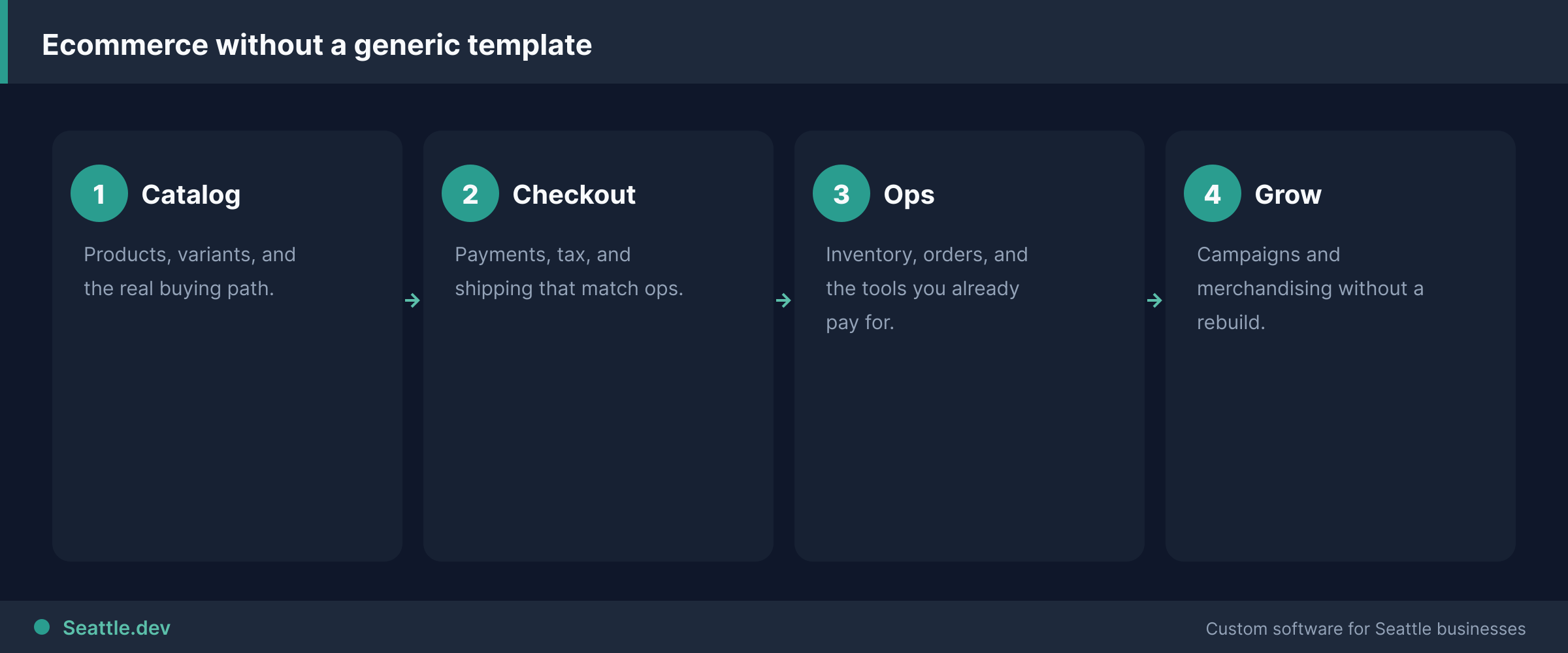
Ecommerce when themes and app stacks fight your business
If a stock Shopify theme and a pile of apps still match how you sell, keep them. I am not here to upsell custom for its own sake. That same filter shows up in making technology decisions for small business. Hire a Seattle ecommerce developer when pricing rules, B2B accounts, multi-warehouse inventory, or brand experience will not fit another generic theme.
I build and modernize online stores for Puget Sound brands: storefronts, checkout, fulfillment sync, and the CRM/ops glue so a sale does not become three manual jobs. Solo senior operator, Pacific hours, fixed-price after a real commerce audit.
Who this is for
DTC and hybrid brands outgrowing theme limits and app conflicts.
B2B sellers who need account pricing, quote-to-order, net terms, or buyer portals, not just a cart.
Teams migrating platforms who cannot afford lost rankings, broken redirects, or a dark year of order history. Treat cutover as a migration project: data migration strategies for switching systems.
Operators who need HubSpot, ERP, or warehouse data in the same customer journey as the storefront.
Who this is not for
A first store with twenty SKUs and no ops complexity. Use Shopify (or similar), a good theme, and a designer. Come back when the tools are the bottleneck.
Pure catalog brochure sites with no real commerce. That is website development, not ecommerce engineering.
"Make us the next Amazon." Scope the store that sells your actual products this year. Fantasy scale architecture is a great way to burn budget.
What I ship
Custom storefronts. Merchandising and product storytelling that a stock theme cannot express, without a performance-killing app soup.
Checkout and payments. Tax, shipping, deposits, subscriptions, failure handling. Stripe and major processors wired cleanly.
Inventory and fulfillment. Warehouse, ERP, or 3PL sync so stock is not a spreadsheet ritual.
CRM and marketing. Orders and customers into HubSpot or your stack with real purchase history. See HubSpot integration.
B2B features. Account pricing, buyer roles, quote flows when wholesale is how you make money.
Cost, stack, and process
Commerce builds vary hard. A focused storefront modernization can sit in the lower five figures. Integrated commerce with multi-system ops often lands in the same $30K–$100K range as other custom software; larger multi-warehouse platforms can push higher. For the broader cost conversation, see understanding custom software costs. I quote fixed-price after a commerce audit: catalog, checkout, ops, analytics.
Stack is pragmatic: platform extension when Shopify or similar can carry the load; headless or custom when it cannot. I recommend the least complex option that meets the rules. Related: API development. Peak-season readiness is part of launch, not an afterthought.
Next step
Schedule a free consultation or request a quote. Bring your catalog quirks and peak-season constraints. I will say build, extend, or stay on the theme, with a straight number either way.