


Seattle Dev

Custom Presentation Platforms

Replace static decks with interactive web experiences: live numbers, product tours, and share links that track attention.
Presenter walking a team through a live deck in a glass-walled conference room

A deck that cannot be updated is a screenshot graveyard.

How we start

Connect, write a plan, then stay in the work

You are not hiring a vendor who vanishes after a kickoff. You get us as an embedded partner who learns the business, then ships against the plan.

01

Connect

Thirty minutes. We learn how the business actually runs: who buys, what is broken, what a good month looks like after launch.

02

Write a plan

What to build, what to skip, an honest range, and whether we are the right fit. You leave with a path, not a pitch deck.

03

Embed

You work with the people who ship it. We stay in the work after launch so the site does not rot the week after deploy.

Presentation Features That Make Your Content Shine

The custom presentation platforms give you powerful tools to engage your audience, visualize complex information, and deliver your message in a way that sticks.

Interactive Data Visualizations

Transform complex data into clear, compelling visuals that your audience can interact with. Show trends, comparisons, and insights in ways that static slides can't match.

Multi-Device Compatibility

Present from anywhere and on any device with platforms that work cleanly across desktops, tablets, and smartphones. Give your audience the flexibility to follow along anywhere.

Audience Engagement Tools

Keep your audience involved with built-in polling, Q&A features, and interactive elements that encourage participation and make your presentations more memorable.

Custom Branded Experience

Make a lasting impression with presentation platforms designed to reflect your brand identity, including your colors, fonts, logos, and overall visual style.

Real-Time Analytics

Understand how your audience engages with your content through detailed analytics that show which slides get the most attention, what questions are asked, and where attention drops.

Integration With Your Systems

Connect your presentation platform with your existing tools like CRM, analytics platforms, or data sources to ensure your presentations always feature the latest numbers.

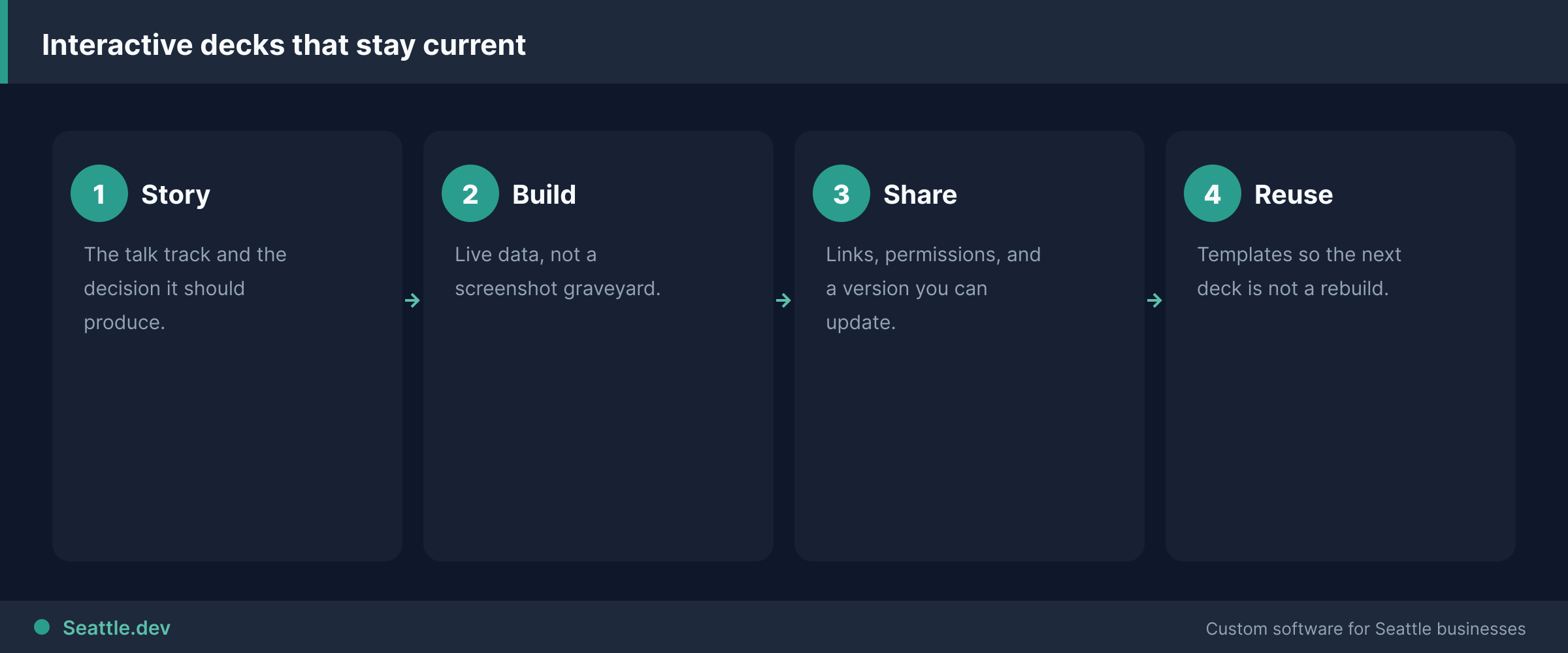
Interactive presentation platform process
Story, live data, share, reuse.

Some stories do not survive PowerPoint

If your product is configurable, your data is the pitch, or your sales process depends on showing rather than telling, a static deck is a ceiling. Custom presentation platforms replace the slide file with an interactive web experience: live numbers, working product tours, branching paths for different audiences, and analytics for what a prospect actually looked at after the meeting.

I build those as focused web applications: yours alone, branded, connected to the systems that hold real numbers. Solo senior operator, Seattle-based, fixed-price when scope is clear. Visual hierarchy for complex numbers follows dashboard UI/UX design principles.

Who this is for

Sales teams with complex or configurable offerings who lose deals in the "let me send you some information" stage. When the story is live data, the same craft as real-time dashboards with live business data applies.

Founders and executives raising money or selling to committees, where the deck gets forwarded to people you will never meet. If the product is really an ops dashboard wearing a pitch costume, start with why your business needs a custom dashboard.

Trade show and field teams who need a kiosk-grade experience on a booth screen, tablet, or phone.

Anyone whose best pitch asset is their own data, not a stock photo collage.

Who this is not for

Internal status decks that change every Monday. Stick with slides or a simple shared doc.

Full client portals pretending to be a pitch tool. If users need accounts, permissions, and ongoing workflows, build a portal.

Buyers who will not connect live data and still want "interactive magic." Screenshots in a fancy shell are still screenshots.

Where interactive beats static

Live data. Current pricing, inventory, case results, portfolio performance from your systems. Nobody re-exports charts the night before a board meeting.

Branching. Jump to the vertical or price tier the room cares about instead of apologizing through forty irrelevant slides.

Interactivity. Calculators and configurators where a CFO types her own numbers and believes the result.

Analytics. Which sections got attention, which got skipped, what they revisited after the follow-up link. Your next conversation starts where interest actually is.

What I build

A branded web app with your narrative flow, presenter controls, share links with tracking, offline modes for bad venue Wi-Fi, and content marketing can update without a ticket for every new "slide."

Because these are focused apps, they are smaller and faster than full portals. Most run weeks, not months, and land well under a typical portal build, often in the lower-to-mid five figures depending on data connections. When the pitch experience grows into ongoing customer access, I graduate pieces into a proper portal rather than overloading the presentation shell. Fixed-price after a short discovery.

Next step

If your best pitch still lives in final-v7-ACTUAL.pptx, schedule a free consultation. Bring the deck and the data. I will show what the interactive version should do and what it should cost.

Talk to an expert

Interactive decks that are actually software

Free 30-minute call. Bring the demo you currently wrestle in PowerPoint. I will say platform vs a better deck.

We take on a small number of new builds at a time so every project gets focused attention.

Prefer a range first? Run the 2-minute cost estimator .

FAQs

What is a custom presentation platform vs a slide deck?

A web experience sales or leadership can open in a browser: live numbers, product tours, branching paths for different audiences, and analytics on what prospects actually open. Not another PowerPoint theme.

How much does a presentation platform cost?

Focused interactive decks often sit in the lower-to-mid custom software band for SMBs, commonly as a slice of a $30,000–$100,000 engagement when tied to product data. Pure static slides are cheaper with ordinary tools; this is for when data and interaction are the pitch.

How long does it take to build?

A focused interactive presentation on a known data set can ship in 4–8 weeks. Live product data, auth for private rooms, and deep analytics push longer. We phase so you can pitch with a working core early.

When should I stick with PowerPoint or Google Slides?

If your story is fixed and your numbers update rarely, stick with slides. Build a platform when the deck is wrong the moment data changes, or when prospects need to click through a real product path.

Talk to an expert

Interactive decks that are actually software

Free 30-minute call. Bring the demo you currently wrestle in PowerPoint. I will say platform vs a better deck.

We take on a small number of new builds at a time so every project gets focused attention.

Prefer a range first? Run the 2-minute cost estimator .

Seattle.dev Footer Background
Seattle Dev

Custom web development and design for Seattle businesses. We specialize in API integration, custom web portals, and business automation.