

What to Expect When Working With a Developer (A Real Talk for Small Business Owners)
You're not failing at technology. You've outgrown the duct tape. Spreadsheets and generic tools stopped matching how the business actually runs, so now you're shopping for a developer and the whole thing feels like a foreign language with invoices attached.
Customer portal so people stop calling for status. Dashboard that doesn't need a three-person scavenger hunt. Software that fits your workflow instead of a vendor's idea of a "normal" company. Fair goals. The hard part is knowing what "good" looks like when you're not technical.
You're not buying keystrokes
When you hire someone for custom software, the valuable parts are:
Understanding the business. "Walk me through an order from first call to cash." "Who touches this field and why?" "What happens in the weird case?" Those questions aren't delay tactics. They're how you avoid building the wrong thing. I've lost count of how many times the described feature and the needed system were different once we watched real work.
Recommendations you didn't know to request. You want Feature X. An experienced developer says Feature Y solves it cheaper. Light pushback from someone who's seen the movie is a feature, not disrespect.
Translation. You speak customers and outcomes. We speak data models and interfaces. Good partners live in both dialects and explain trade-offs in dollars and risk, not jargon.
Honesty about bad ROI. Not everything is worth building. If the idea is expensive and the upside is tiny, you want to hear that before kickoff.
Money, without the flinch theater
Ballparks I use with small and mid-size businesses (same bands as my FAQ, not fantasy startup Twitter):
- Simple internal dashboard: roughly $30K–$50K
- Customer or partner portal: roughly $50K–$75K
- Broader platform with more integrations and roles: roughly $75K–$150K
Stomach drop is normal. Compare it to what the problem already costs: labor, lost deals, errors, tools that almost work. That's the baseline. Not zero.
I price fixed, not hourly fishing. If I quote $50,000, that's the number unless you change scope. Overruns are my problem. Anyone who won't put a number in writing is handing you the risk.
Payment that protects both sides:
- 30% at start (planning and early build)
- 40% at midpoint (core path working)
- 30% at launch (tested, deployed, usable)
You're not wiring 100% into the void. I'm not financing months of work on hope.
What the first conversations should feel like
Heard, not sold. Lots of questions before a package appears. A pitch in the first fifteen minutes is a sales script, not discovery.
Clearer, not dumber. If you leave more confused than you arrived, communication won't magically improve under deadline.
Realistic, not magical. Nobody ships your dream system in three weeks for pocket change. Good partners show the trade: simpler in six weeks vs. more robust in ten, and what those extra weeks buy.
Questions that separate pros from talkers
When you're comparing people, score them with the vendor scorecard. Structure beats charm.
"Have you built something like this?"
Good: similar work, examples, how it maps to you.
Bad: "I can build anything."
"How do we communicate?"
Good: weekly demos of working software, async updates, a path for urgent issues.
Bad: "Whatever you want" with no process.
"What if I don't like it?"
Good: early visible increments, course-correct before the end, ownership of misunderstandings.
Bad: "That won't happen."
"What if you're gone after launch?"
Good: you own the code, docs exist, transition help is available.
Bad: squirming. Hostage relationships are a hard no.
Your half of the partnership
Typical owner time across a project is about 10–15 hours total: a few hours up front, 30–60 minutes a week, a couple hours at the end for testing and training. The number one delay is not code. It's unanswered decisions. A week of silence is a week of slip.
Fast feedback. "Yes" or "not quite, here's why" within a day or two keeps context warm.
Access to real users. If ops will live in it, I need time with ops. You can broker it; you can't substitute for it forever.
Say when you're lost. "I don't understand why we're doing it this way" is a gift. It catches wrong assumptions early.
Show up for the cadence. Weekly check-ins. Reasonable reply times. Disappearing for three weeks freezes the build.
Walk away if you see these
- 100% payment before work starts
- Zero examples of prior work
- Refusal to write scope down
- Outlier promises (two weeks and $3K when everyone else says eight weeks and real money)
- Slow, sloppy communication during sales (it gets worse later)
What an 8-week-shaped project feels like
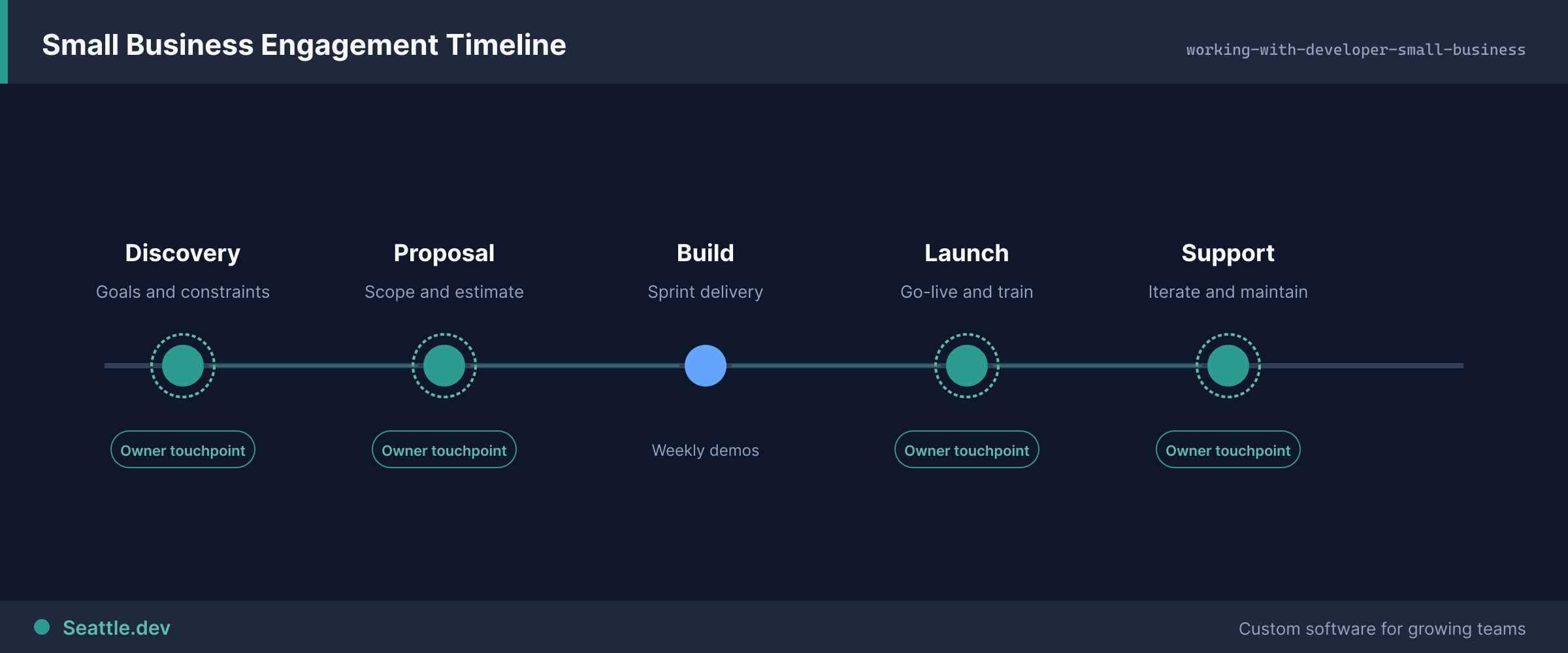
Most small business builds land somewhere in the 6–12 week band. A common rhythm:
Weeks 1–2. Deep discovery, decisions on phase one, functional mockups, check-in rhythm. Change is cheap here.
Middle weeks. Working slices every week. Rough is fine. "Does this do the job?" matters more than polish.
Final stretch. Hardening, real data, training, launch. Soft launch with a small group when it makes sense.
After launch. Real users find gaps. Budget for that. It's normal, not failure.
The relationship after go-live
The first project is often the start, not the transaction. Features, integrations, process changes. Someone who already knows your system and how you decide is leverage.
Hosting commonly runs $200–$500 a month. Ongoing support plans start around $750 a month: a person who knows the build, not a ticket lottery. Plan for that line item if the software matters.
How to choose
Technical skill is table stakes. You're picking a partner: clear communication, respect for your budget, curiosity about the business, fixed-price honesty. You should feel like they're on your side of the table.
Let's talk like adults
If custom software is on the table and this tone fits how you want to work, as a Seattle website developer I'll give you:
- Plain language
- A straight yes/no on whether custom makes sense
- Timeline and budget without theater
- A clear picture of what you'd get
Schedule a consultation. If I'm the wrong fit, I'll say so and point you elsewhere when I can.
No pitch deck. One business owner to another about whether technology is the right lever right now.
Free PDF download: Want to apply this to your situation? Download the Developer Vetting Checklist: a fillable worksheet you can print, share with your team, or hand to a vendor. No email gate.