

Technical Co-Founder for Your SaaS Startup (Without Giving Up Equity)
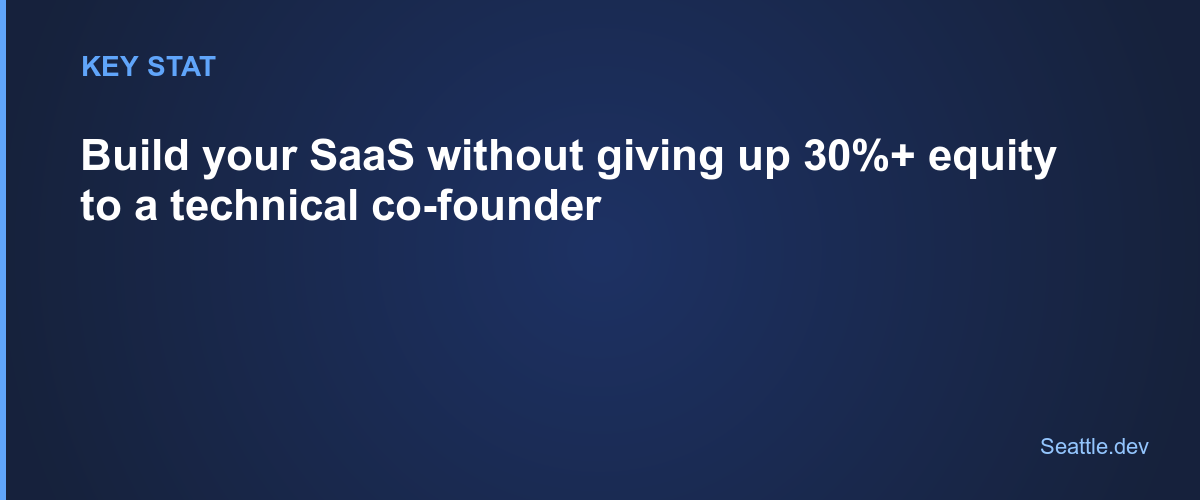
If you can fund an MVP in cash, giving a stranger 25% of your company for "technical co-founder" energy is almost always a bad trade. I'll defend that position for the rest of this piece.
Non-technical founders get stuck on the same fork: you need real technical judgment early, and the default market offer is equity. Twenty to forty percent, for someone you just met, before product-market fit, before you know if the relationship works. What if they leave in six months? What if you could have paid for the same leadership and kept the ownership for investors, key hires, and yourself?
What you're actually buying when you want a technical co-founder
Not "someone who codes." Judgment.
Stack and architecture calls that outlive the first release. Multi-tenant vs. single-tenant for B2B SaaS. What you build vs. what you bolt on (Auth, payments, email, hosting). Security and compliance baked in early because retrofits are brutal. These choices either enable a pivot later or trap you in a rebuild.
MVP that validates, not impresses. Ruthless scope. Features users need this quarter, not the roadmap fantasy. Architecture that can evolve without being a cathedral. Launch something useful in 6–8 weeks when the scope is honest; expand after you learn what people actually do.
Investor and hire readiness. Credible answers in diligence. Sane timelines and budgets. Coding standards, interview loops, and docs so your first senior engineer doesn't inherit a junk drawer.
Vision that prevents problems. When to take on debt, when to refactor, when infrastructure investment is premature theater. Tactical developers fix tickets. Strategic technical partners keep you off the wrong mountain.
If someone only offers tickets-per-sprint, they're a contractor. Fine for some work. Not a co-founder substitute.
Why the classic equity split is often a trap
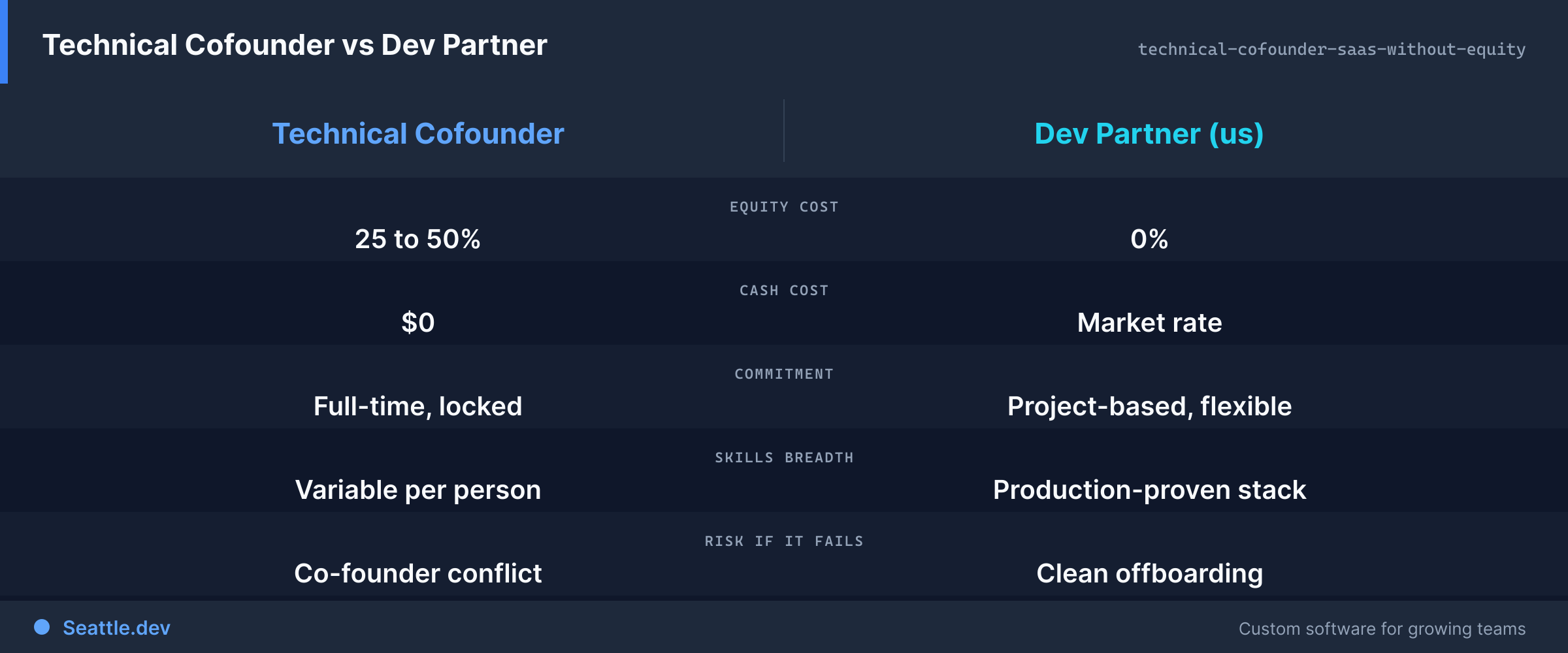
The 20–40% technical co-founder model made more sense when startups were multi-year garage projects with no cash. Modern SaaS founders often have savings, pre-seed, or early revenue. The model didn't update.
Dilution is immediate and sticky. You hand over a huge slice before you know if the partnership works. If they leave after six months, you still have cap-table mess, vesting fights, and awkward investor explanations.
Timelines diverge. You might want a clean $10M exit in three years. They might want unicorn mythology. That gap shows up in every technical priority fight.
Cash-rich founders overpay with equity. If you can pay market rates for senior technical leadership and an MVP, equity is usually the more expensive currency. You're not "saving money." You're prepaying with ownership you can't get back cleanly.
Departure risk is real. Life happens. Interests change. A departed co-founder with a fat equity stake is a legal and fundraising headache, not a free lesson.
I'm not saying equity co-founders never work. I'm saying most non-technical founders reach for equity because it's the story they heard, not because they ran the math.
The non-equity alternative, in plain terms
Technical co-founder services swap unlimited equity-for-presence for defined scope and cash.
I structure the build the same way I structure every fixed-price project: 30% at start, 40% at midpoint, 30% at launch. If I quote $50,000, that's what you pay. Overruns are my problem unless you change scope. Known cash cost. Zero dilution. That's the whole pitch in one sentence.
In practice that looks like:
- Fixed-price MVP with co-founder-level architecture and product judgment included
- Weekly sessions on trade-offs, not status theater
- Investor prep and technical diligence support
- Documentation your future hires can actually use
- Optional monthly advisory after launch when you still want a technical brain on call
Total investment often lands in the $50K–$150K band depending on MVP complexity. Serious money. Still a rounding error next to 25% of a company that works.
This model fits when you have capital (bootstrap, pre-seed, personal), you want max ownership through early stages, you need strategic technical leadership more than a full-time roommate CTO, the first chunk of work is bounded (MVP, then hire), and you want the freedom to change partners if the fit is wrong.
What "strategic" has to mean, or you're just buying hours
Stack for your constraints, not the developer's comfort zone. Hiring market, cost at 100 users vs. 100,000, ecosystem longevity. Wrong stack is a multi-year tax.
Architecture as business strategy. Isolation model, API surface, compliance path, performance assumptions. How you architect determines what you can charge and how fast you can onboard.
Build vs. buy without ego. Auth0 vs. custom auth. Stripe vs. inventing payments. Managed hosting vs. playing sysadmin. Shortcuts that protect runway are features, not sins.
MVP scope that can ship. Inexperienced teams build everything. Real technical co-founders cut. Phased SaaS MVP development: useful launch first, features after evidence.
Handoff assets. Pitch materials, diligence answers, onboarding docs, interview process. You're buying independence, not dependency.
How the build itself should feel
Not over-engineered perfection. Thoughtful structure, tests on critical paths, docs that explain why, patterns a new hire can follow. You're buying a foundation that can change as you learn.
Plan integration points early. Most SaaS products live or die on connecting to other tools. Abstraction beats hard-wiring.
Security and compliance from day one when your market requires it. Retrofits for GDPR, SOC 2, or HIPAA-ish realities are expensive and sometimes impossible under a deadline.
You don't need million-user scale on day one. You do need a path that doesn't require a full rewrite the first time growth shows up.
After the MVP: advisory, not a second co-founder on the cap table
Monthly strategy time (often a few hours), architecture review as the product mutates, hiring help, diligence support, vendor selection. Enhancement work on a project basis when you need it.
Someone who already knows the system is worth more than a random support queue. Ongoing support for work I maintain typically starts around $750 a month, which is not a full-time CTO salary, and not 25% of your company either.
The endgame is healthy: help you hire, transfer knowledge, and step back when internal leadership can carry it.
The math founders avoid
Assume modest success: $5M valuation in three years.
Equity co-founder at 25%: $1.25M of value gone, plus further dilution if they participate in early rounds.
Cash technical partnership: say ~$75K for MVP, ~$36K for 18 months of advisory at $2K/month, ~$25K of enhancements. Roughly $136K cash. You keep ownership (minus investor dilution you chose).
Even a full comprehensive platform in the $75K–$150K range is small next to seven figures of equity. Pressure-test your own range with the cost estimator before you romanticize "finding a technical co-founder."
Not every strong developer. You want:
- A decade-plus of shipping, ideally with startup scar tissue
- Business instincts: unit economics, fundraising reality, hiring
- Domain familiarity when it matters (integrations, compliance, market norms)
- Ability to explain trade-offs without making you feel stupid
- Pragmatism: good enough to launch beats beautiful and late
Perfectionists ship six months late and 2x over budget. You need someone who can take strategic shortcuts on purpose.
When equity still makes sense
I'll give the other side its due, briefly.
Equity co-founder fits when you truly have no capital to pay for development, you need full-time technical leadership from day one, the product is deeply technical and the CTO is the company, the path to revenue is measured in years, and you've found someone you trust completely after real diligence, not a weekend demo day crush.
Cash services fit when you can pay, you want ownership early, the first need is bounded, you want an exit hatch if the relationship sours, and you plan to hire internally within 12–18 months.
If you have money and still default to equity because it feels more "startup," pause. That's culture, not strategy.
What to do next
If non-equity technical partnership sounds like the grown-up version of what you actually need, schedule a consultation. We'll talk about the product, whether this model fits, a realistic MVP slice, and a transparent number. If a traditional co-founder is the better path for you, I'll say that. If the idea isn't ready for code, I'll say that too.
You don't have to give away the company to get serious technical leadership. Pay for the expertise. Keep the equity for people and capital that compound.