
Business StrategyTim Mushen

Why Seattle Businesses Choose Local Custom Software Development Over Remote Teams

Discover the advantages of working with a Seattle-based custom software developer for dashboards, portals, and business applications. Learn why proximity, timezone alignment, and local expertise matter.
Seattle software developmentlocal developerPacific Northwest techBellevue custom softwareWashington state development
Why Seattle Businesses Choose Local Custom Software Development Over Remote Teams

Why Seattle Businesses Choose Local Custom Software Development Over Remote Teams

The remote work revolution promised that geography doesn't matter—talented developers anywhere can build software for clients anywhere. While technically true, this oversimplification ignores reality that many Seattle businesses discover after struggling with distant development teams: proximity, timezone alignment, and local business context often make the difference between software projects that succeed and those that disappoint.

This isn't nostalgia for pre-remote work days or skepticism about distributed teams' capabilities. Remote development works brilliantly for certain scenarios—open source projects, well-defined specifications, and mature products with clear roadmaps. But for custom business software where requirements evolve through conversation, where quick iterations matter, and where understanding local business context is essential, working with a Seattle-based developer provides advantages that video calls can't fully replicate.

The Timezone Reality Nobody Talks About

Timezone differences sound trivial until you're living with them daily. When your development team operates on Eastern European time, your morning question gets answered their next morning—your evening. Simple clarifications that would take five minutes in person require 24-hour email cycles.

Real-Time Collaboration Actually Matters For custom portal and dashboard development, specifications don't arrive fully formed. They emerge through conversation. You describe what you need, the developer asks clarifying questions, you realize there's an edge case you hadn't considered, and the developer suggests an approach you hadn't imagined. This back-and-forth happens naturally when you're in compatible timezones. It becomes painfully async when you're not.

Pacific timezone alignment means questions get answered immediately, screen shares happen spontaneously, and problems get resolved in hours instead of days. When development teams work during your business hours, you're not waiting until tomorrow for answers that could come today.

Emergency Response When It Matters Production issues don't respect timezones. When your customer portal goes down at 2 PM Seattle time, you need someone who can jump on a call immediately—not someone wrapping up their workday 9 hours ahead who'll look at it tomorrow. Local developers are available during your crisis hours because they're also their working hours.

Meeting Schedules That Don't Require Sacrifice With Eastern or international teams, someone always attends meetings at inconvenient times. Either you're joining calls at 6 AM, or they're working evenings. This creates resentment and fatigue that erodes working relationships. Pacific timezone alignment means normal working hours for everyone.

Understanding Seattle Business Context

Seattle and the Pacific Northwest have unique business characteristics that local developers understand implicitly while distant teams must learn.

Tech Industry Expectations Seattle businesses are spoiled by proximity to Microsoft, Amazon, and hundreds of tech companies. User expectations are high, performance standards are demanding, and sophistication about software is greater than in many markets. Local developers understand these expectations because they're working with multiple Seattle clients simultaneously and see consistent patterns.

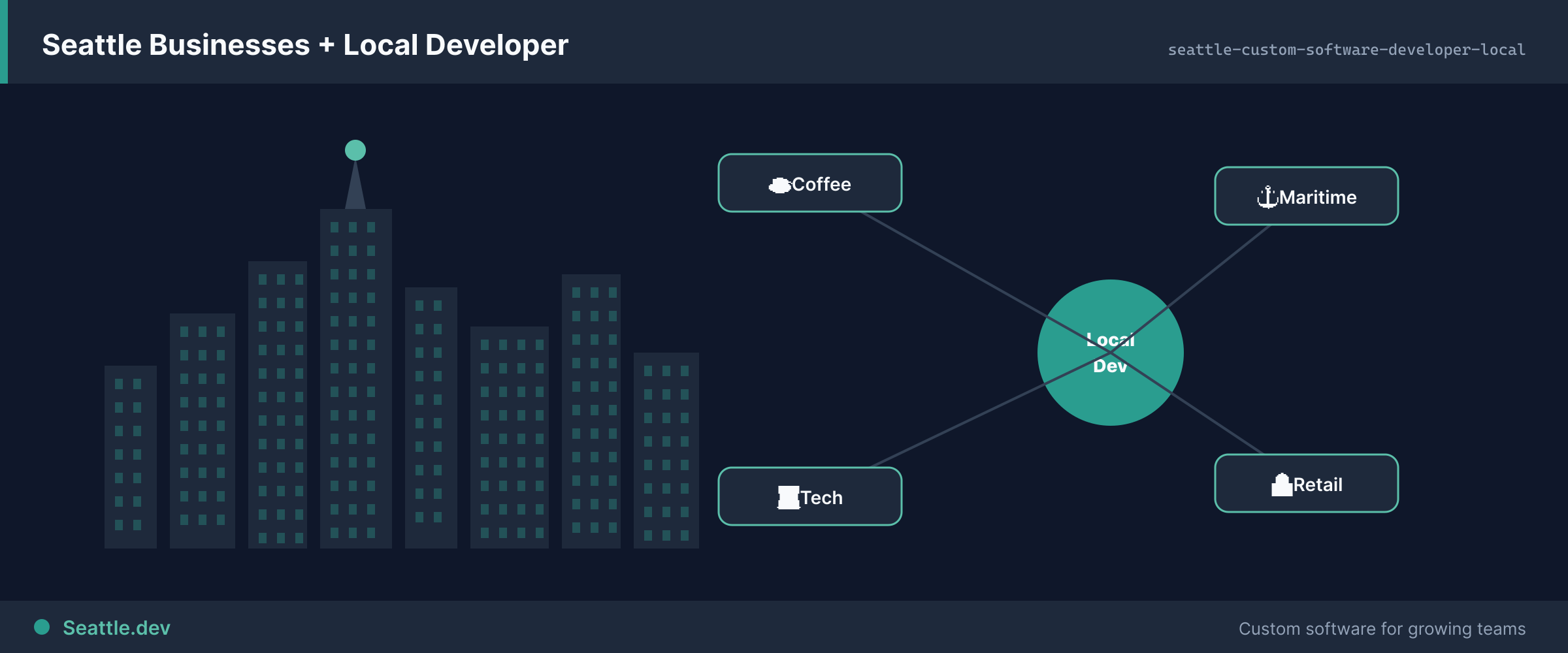
Industry Concentrations The Puget Sound region has industry clusters—maritime and logistics, healthcare and biotech, aerospace and manufacturing, clean energy and sustainability. A Seattle developer working with companies across these sectors develops familiarity with industry-specific requirements, compliance needs, and workflow patterns that benefit all clients.

Regional Business Networks Business happens through networks. A Seattle-based developer working with multiple local companies can facilitate introductions, recommend complementary service providers, and bring insights from similar companies facing similar challenges. This network effect doesn't exist when your developer works with clients scattered globally.

Understanding Local Regulations Washington state has specific regulations around data privacy, employment law, and industry-specific compliance. Local developers encounter these requirements repeatedly and know how to address them. Developers working primarily with companies in other states and countries won't have this familiarity and may miss requirements that seem obvious locally.

The Value of Face-to-Face Interaction

Video calls are remarkably good, but they're not quite the same as meeting in person for critical conversations.

Kickoff Meetings Set the Tone Starting projects with in-person meetings builds rapport that's hard to replicate remotely. Reading a room, picking up on body language, and having sidebar conversations during breaks provide context that shapes how you work together. These initial meetings establish trust and communication patterns that carry through the entire project.

Whiteboarding for Complex Problems When discussing complex portal architectures, data flows, or workflow logic, sketching on a whiteboard while talking through scenarios is more effective than screen sharing diagrams. The physical act of drawing together, erasing and revising, and thinking visually creates shared understanding faster than digital alternatives.

On-Site Observation For portals and dashboards supporting specific business operations, watching people work in their environment reveals requirements that interviews miss. Seeing the physical workspace, the tools people use, and how information flows provides context impossible to capture in Zoom calls. Local developers can easily spend a few hours observing workflows in person rather than attempting remote shadowing sessions.

Impromptu Problem Solving When challenges arise, the ability to drive to your office (or invite you to theirs) for a few hours of focused problem-solving is valuable. Sometimes complex issues require extended face-to-face time working through options, reviewing code together, and making decisions collaboratively. This is possible but awkward when coordinating across distance.

The Local Accountability Factor

Working with someone local creates different accountability dynamics than remote relationships.

Reputation Matters Locally In Seattle's tight-knit tech community, reputation is everything. Bad work gets discussed, poor client treatment becomes known, and word spreads quickly. Local developers have strong incentive to deliver excellent work and maintain positive client relationships because their regional reputation directly affects their business.

Remote developers working with clients across the globe face less concentrated reputation risk. One difficult client relationship in Seattle barely affects their broader reputation when most clients are elsewhere.

Easier Legal Recourse While hopefully never necessary, local relationships mean clear legal jurisdiction, easier contract enforcement, and practical recourse if things go catastrophically wrong. Dealing with legal disputes across international boundaries is exponentially more complex.

Visible Business Presence A developer with a physical presence in the region—whether an office, coworking space, or even just a consistent local address—demonstrates commitment to the market. You can visit their location, see their operation, and verify they're a legitimate ongoing concern rather than a transient remote operator.

Cost Considerations Beyond Hourly Rates

Remote developers often advertise lower hourly rates, making them appear cheaper. Honest total cost analysis reveals more nuanced truth.

Hidden Coordination Costs Timezone differences and communication challenges slow projects. Tasks that would take one day with back-and-forth conversation take three days async. This extends timelines and increases total project costs even if hourly rates are lower.

Rework From Misunderstandings When communication is more difficult, misunderstandings are more common. Features get built to specifications that didn't match actual intent. Rework extends timelines and increases costs. Clear communication with local developers reduces expensive misunderstandings.

Opportunity Cost of Delays Every week your portal development is delayed is a week you're not realizing business value. If async communication extends a project from 10 weeks to 14 weeks, that's a month of delayed value. For revenue-generating portals or efficiency-improving dashboards, these delays have real business cost beyond just development fees.

Premium for Availability and Responsiveness Paying slightly higher rates for Seattle-based developers who are immediately available, rapidly responsive, and can meet in person when needed often provides better value than distant teams with lower rates but coordination overhead.

When Remote Development Makes Perfect Sense

To be clear, remote development isn't wrong—it's just right for different situations.

Remote Works Great For:

  • Well-defined specifications that don't require extensive back-and-forth
  • Mature products with established roadmaps and clear requirements
  • Projects where cost is the overwhelming priority and coordination overhead is acceptable
  • Ongoing maintenance work that doesn't require much communication
  • Specialized expertise available only in specific geographic areas
  • Augmenting local teams with specific technical skills

Local Makes More Sense For:

  • Custom portal and dashboard development where requirements emerge through conversation
  • Projects requiring frequent stakeholder input and collaboration
  • Software where understanding business operations is essential
  • New business applications where requirements are discovery-focused
  • Projects where timeline is critical and delays are costly
  • Situations where meeting in person provides significant value

Finding the Right Seattle Developer

Not all local developers are created equal. Look for:

Deep Local Experience Years working with Seattle and Pacific Northwest businesses, understanding of regional industries and their specific needs, network of local references you can check, and participation in local tech community.

Specialization Alignment Focus on portal and dashboard development specifically, experience with your industry or similar businesses, technology stack that matches your needs, and portfolio demonstrating relevant past work.

Communication and Availability Responsive during Pacific business hours, willingness to meet in person for kickoffs and key milestones, clear communication style and project management approach, and references specifically mentioning communication quality.

Business Stability Established business presence (not just starting out), diverse client base reducing dependency on any one client, professional liability insurance, and clear contract and business practices.

Seattle Development in Practice

Working with a Bellevue-based developer on custom portal development typically looks like this:

Week 1: In-Person Kickoff Meet at your office or theirs for half-day workshop. Walk through your current processes, discuss pain points, sketch out initial portal concepts, and establish communication patterns and project timeline.

Weeks 2-8: Active Development Daily or every-other-day check-ins during Pacific morning hours. Weekly demos showing working features. Quick questions answered in real-time. Problems identified and resolved the same day.

Week 9: In-Person Review Return to office to review complete beta with key stakeholders. Watch people interact with the portal. Identify friction points. Make decisions about refinements collaboratively.

Weeks 10-12: Refinement and Launch Final adjustments based on feedback. Staging environment for user testing. Launch support available during Pacific business hours. Post-launch availability for immediate issue resolution.

This rhythm—mostly remote work with strategic in-person collaboration at key milestones—balances efficiency with relationship-building and effective communication.

The Local Advantage for Long-Term Partnerships

Custom software isn't one-and-done—it evolves with your business. Long-term relationships with local developers compound advantages:

Ongoing familiarity with your business deepens over time, ability to meet periodically to discuss strategy and roadmap, availability for emergency support during your business hours, and accumulated knowledge about your systems, data, and processes stays local rather than leaving with distant contractors.

Many Seattle businesses work with the same local developer for years or even decades, with relationships evolving from initial portal development through ongoing enhancements, additional projects, and strategic technical consulting.

Making Your Decision

Choosing between local and remote development isn't ideological—it's practical. For straightforward, well-defined projects where cost is primary concern, remote can make perfect sense. For custom portal and dashboard development where collaboration, communication, and business context understanding matter significantly, local Seattle developers often deliver better value despite potentially higher rates.

The question isn't "is Seattle development universally better?" It's "given my specific project, timeline, budget, and communication needs, what arrangement gives me the best probability of success?"

Let's Talk About Your Project

Based in Bellevue serving Seattle and the broader Pacific Northwest, I specialize in custom portal and dashboard development for businesses that value responsive communication, local availability, and understanding of regional business context.

Schedule a consultation to discuss your project in person (or via Pacific-timezone-friendly video call). We'll talk about your specific needs, explore whether local development makes sense for your situation, and provide honest guidance about the best path forward—whether that's working together or another arrangement that better serves your needs.

The consultation is free, the advice is honest, and we'll both walk away with better understanding of your options.

Ready to Start Your Project?

Let's discuss how we can help bring your ideas to life

Schedule a Free Consultation
Bandmate Footer Background
Seattle.dev Logo

Custom web development and design for Seattle businesses. We specialize in API integration, custom web portals, and business automation.