
Multi-Tenant Portal Architecture: Building Scalable B2B Platforms
Multi-tenancy answers one question: can you serve many organizations from one platform without running a private deployment for each of them?
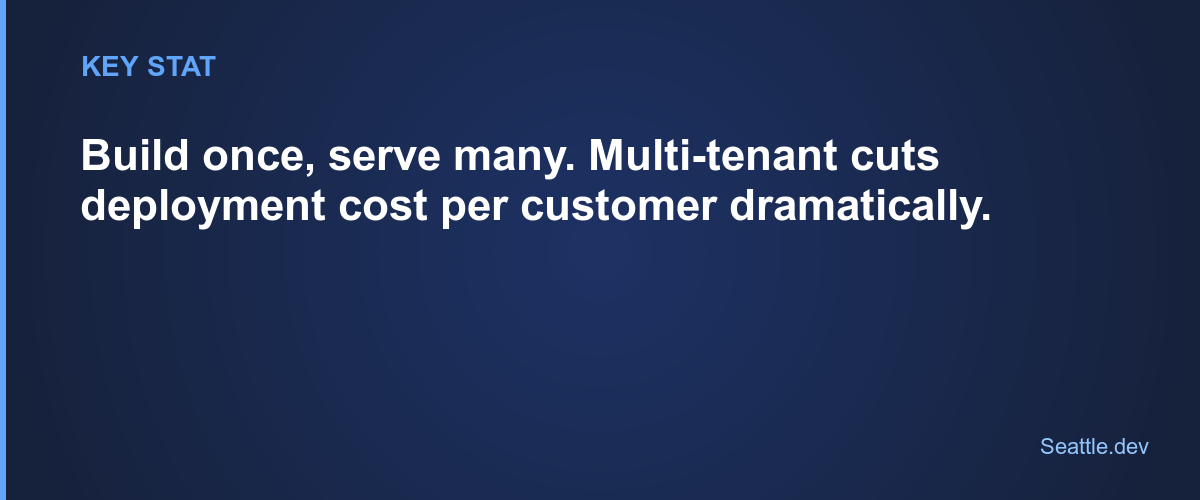
Get it right and onboarding a customer is configuration, not a custom install. Get it wrong and every new logo multiplies ops work: separate infrastructure, separate patches, separate "why is this one different" debugging. You're not running a product. You're running a fleet of cousins that all need babysitting.
This isn't only for funded SaaS companies. Any B2B portal with distinct organizations (partners, dealers, franchisees, client companies) benefits from the same isolation and configuration patterns. The rest of this post is the decision set I walk through when someone is actually building one.
What multi-tenancy means in practice
Multiple tenants share application infrastructure while keeping data and configuration separated. Each tenant feels like they have a private system. Behind the curtain they share codebase, deployment, and usually most of the data plane.
Single-tenant is the alternative: separate app, separate database, separate everything per customer. Easier on day one. Expensive by customer twenty. Every security fix is N deploys. Every feature ships inconsistently because each environment drifts.
Multi-tenancy centralizes that cost. One deploy, all tenants. One security patch, all tenants. The hard part is isolation and customization without turning the shared core into a mess of special cases.
Three data isolation patterns
This is the architectural fork that shapes everything else.
Shared database, shared schema, tenant ID on every row. One set of tables. Application code adds WHERE tenant_id = ? to every query. Maximum density: new tenants are rows, not infrastructure. Cross-tenant analytics is easy because the data lives together. The failure mode is catastrophic: forget a filter and you've leaked one tenant's data into another's result set. Recovery and selective restore are messy because rows are intermingled.
Shared database, schema (or table set) per tenant. Same database server, hard separation at the schema boundary. Switching schema per request is how isolation is enforced. Leaks require querying the wrong schema on purpose. Per-tenant backup and restore are simpler. Cost: schema sprawl, operational overhead at high tenant counts, and database limits if you grow into the thousands.
Database per tenant. Strongest isolation. Physical separation. Straightforward compliance story. Data residency by hosting different tenants in different regions. Cost: ops multiplies. Backups, monitoring, migrations, and scaling become N problems. Cross-tenant reporting needs a separate pipeline. Use this for large enterprise customers with hard isolation requirements, or when a tenant is big enough that dedicated infrastructure was inevitable anyway.
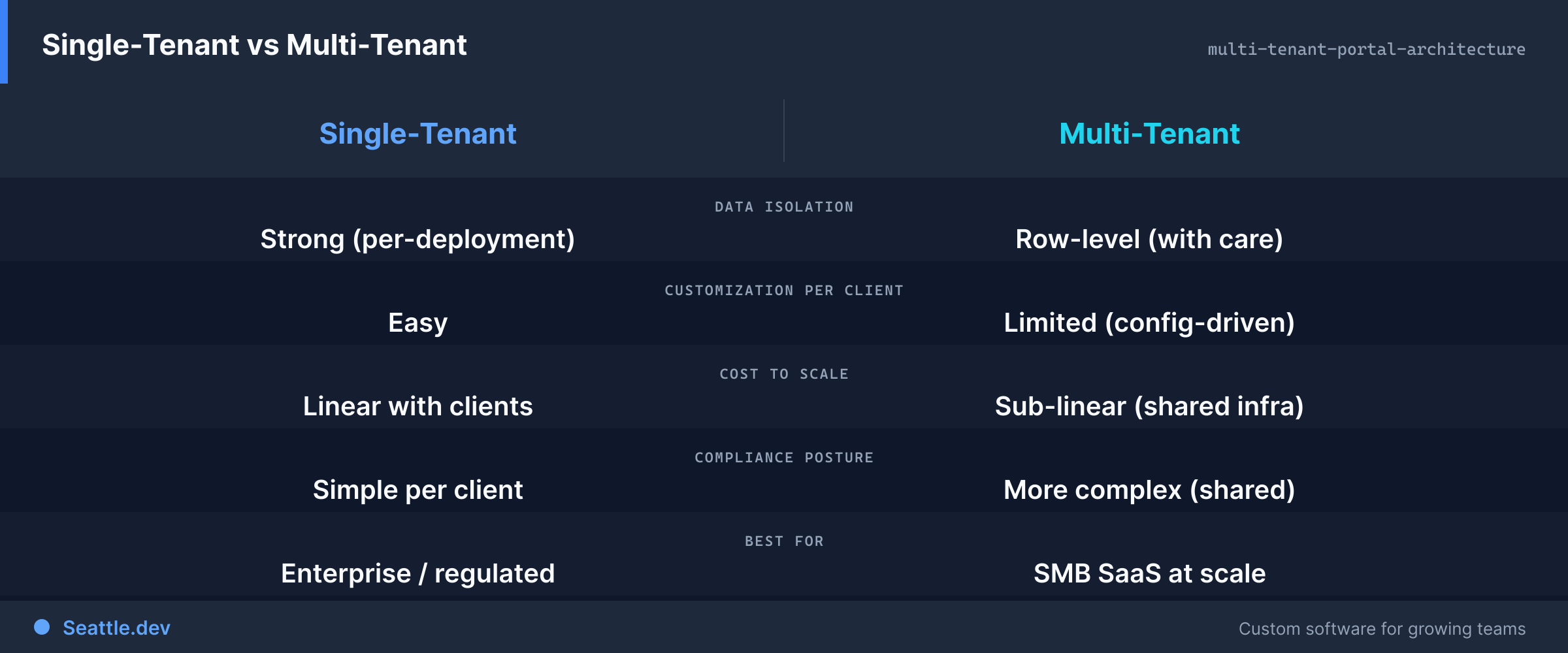
My default for early B2B products is shared schema with aggressive database-level enforcement (next section), with a documented path to move heavy or regulated tenants onto dedicated databases later. Starting per-database-per-tenant "for safety" usually just means you never build the product discipline isolation actually requires.
Isolation you can trust
Application WHERE clauses are not enough. Bugs ship.
Enforce at the database when you can. PostgreSQL row-level security policies catch forgotten filters. Defense in depth: the DB refuses the leak even if the app is wrong.
Establish tenant context at auth, then never lose it. On login, resolve tenant membership and bind it to the session. Every request carries and validates that context. Missing or ambiguous context fails closed. Guessing is how incidents start.
Make cross-tenant access explicit and logged. Support tools, admin reports, internal dashboards: if they touch more than one tenant, they are privileged operations with audit trails. No silent cross-tenant joins.
Test isolation continuously. Seed multiple tenants in the suite. Assert queries for tenant A never return B. Simulate the classic mistakes and prove the protections fire.
Alert on suspicious multi-tenant access patterns. Instrumentation that flags queries spanning unexpected tenants pays for itself the first time it catches a bug in staging.
Customization without forking the product
Standardization keeps the platform operable. Customization keeps tenants from leaving. Balance them deliberately.
Prefer configuration over custom code: branding, fields, workflow toggles, feature flags. Flags also give you progressive rollout and tier gating without shipping separate builds.
Use hierarchical config: platform defaults, tenant overrides, optional user overrides. Keep the resolution path boring and documented.
Design extension points (webhooks, scripted automations, plugins) instead of "we'll just patch core for Acme." Custom logic stays outside shared paths so one tenant's exception can't break the next deploy for everyone else.
If a sales call requires a fork of the core, you're not selling multi-tenant software anymore. You're selling consulting with a SaaS logo.
Scaling under uneven load
Tenants are not equal. A few will generate most of the traffic. Some will have ten users and a quiet database. Architecture that pretends otherwise either over-provisions for everyone or lets large tenants flatten everyone else.
Identify heavy tenants and treat them differently: dedicated app capacity, rate limits, priority queues, or a move to dedicated storage. Cache with tenant IDs in keys and per-tenant cache budgets so one customer doesn't own Redis.
Plan the day the shared database needs to split. Shared schema makes tenant moves harder; if you start there, design export/import and dual-write tooling before you're doing it under an incident. Measure per-tenant consumption (queries, storage, bandwidth, compute) so pricing and capacity planning aren't guesses.
Tenant lifecycle
Provisioning should be automated: tenant record, schema or namespace, defaults, first admin user. Manual onboarding that requires an engineer for every signup does not scale and introduces configuration drift.
Trial-to-paid upgrades must preserve data. Users should see expanded capabilities, not a migration project. Billing integration usually means Stripe (or similar) through a real custom API development layer: verify webhook signatures, process idempotently, never double-charge or flip a plan twice because a webhook retried.
Build migration tooling early: shared to dedicated, region moves, tier changes. Emergency migrations under customer pressure are how you lose weekends.
Offboarding needs a clean path: suspend, export, delete on the schedule compliance requires. GDPR-style deletion is an architecture requirement, not a support playbook note.
Billing and tiers
Usage-based pricing needs infrastructure-level metering you can defend in a dispute. Tiered products need fast feature-flag checks (these run constantly). Decide hard limits vs overages vs forced upgrades before a tenant hits the wall at 2 a.m. Support enterprise special pricing as configuration, not one-off code branches.
Compliance and residency
Enterprise deals often require geographic residency and certifications. Design so tenants can land in region-specific infrastructure without inventing a second product. Compliance needs vary by tenant: audit logging, retention, access policies should be configurable without forking.
Audit logs are per-tenant, append-oriented, and ideally stored so operational deletes can't erase the trail. When a customer's security team audits you, you want documentation of isolation, patch process, monitoring, and incident response ready, not drafted under deadline.
Cost and sequencing for founders
On the business side, I tell every founder scoping a custom web portal or SaaS MVP with multi-tenant architecture the same thing: the number of user types and permission levels is one of the biggest cost drivers. Each distinct role multiplies the access-control matrix you design, build, and test. A comprehensive business platform with complex multi-user requirements typically runs $75,000–$150,000 and takes 12–16 weeks to build properly. I quote fixed price with 30% at kickoff, 40% at midpoint, and 30% at launch. I push phased release: core tenant isolation and the primary workflows first, then customization depth, billing tiers, and compliance features.
Multi-tenancy is a spectrum. You can start shared for everyone and peel large customers onto dedicated infrastructure later. You can start with thin configuration and grow extension points as real tenants demand them. What you cannot do cheaply is bolt real isolation onto a single-tenant app after the fifth customer is already live.
If you're designing a B2B platform and need architecture that won't paint you into a corner at tenant fifty, schedule a consultation. We'll map isolation strategy, customization boundaries, and a build sequence that matches how you actually plan to sell.