
[object Object]

The build versus buy decision for business software is rarely as simple as comparing price tags. The obvious costs—development expenses versus subscription fees—are just the starting point. Hidden costs, opportunity costs, and long-term value considerations often matter more than upfront spending but get overlooked in analysis that focuses only on immediate outlays.

Custom Portal ROI: How to Calculate the Value of Building vs. Buying

The build versus buy decision for business software is rarely as simple as comparing price tags. The obvious costs—development expenses versus subscription fees—are just the starting point. Hidden costs, opportunity costs, and long-term value considerations often matter more than upfront spending but get overlooked in analysis that focuses only on immediate outlays.

This oversight leads businesses to make expensive mistakes in both directions. Some organizations overspend on custom development for problems that off-the-shelf tools solve perfectly. Others commit to SaaS platforms that seem cheap initially but become expensive prisons—inadequate for needs, expensive to escape, and costly in terms of operational inefficiency and limited capability.

Making the right choice requires honest assessment of total costs, realistic timelines, and clear understanding of what you're actually trying to accomplish. Let's build a framework for evaluating custom portal development against alternatives that leads to better decisions.

Understanding Total Cost of Ownership for Off-the-Shelf Solutions

Off-the-shelf platforms advertise obvious subscription costs but hide many expenses that only become apparent after commitment. Honest cost analysis accounts for everything you'll actually spend.

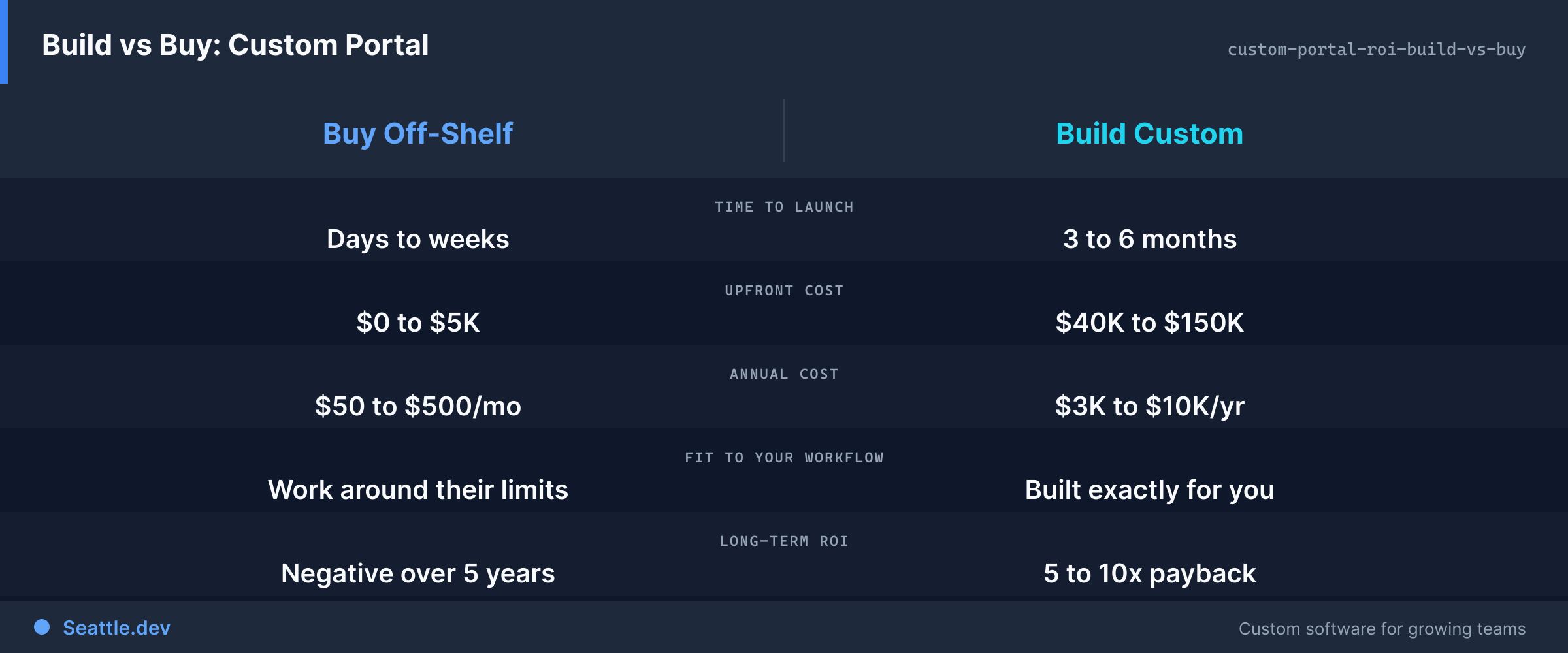
Subscription fees compound over time. That $50/month entry tier looks affordable until you realize it lacks features you need. The $500/month professional tier gets you closer but still requires the $2,000/month enterprise tier for the integration capabilities you can't work without. Suddenly you're spending $24,000 annually—and that's before adding users, which often multiplies costs linearly. Calculate what you'll actually spend for needed features and expected user count, then project over five years. Subscription costs never decrease and frequently increase as platforms shift pricing.

Integration and customization costs add up quickly. Off-the-shelf platforms rarely work exactly as needed. You'll need custom integrations to connect with existing systems, configuration work to match your workflows, and potentially professional services from the vendor or consultants. These costs often match or exceed annual subscription fees but get classified as "one-time" expenses—until you need changes and pay again.

Hidden operational costs create ongoing burden. Generic platforms require workarounds for capabilities they don't support natively. Your team exports data manually, duplicates information across systems, or performs steps the platform should automate. Quantify these operational inefficiencies. If two people spend five hours weekly working around platform limitations, that's 520 hours annually—over $39,000 in labor cost at $75/hour fully loaded.

Migration and exit costs create lock-in. Switching platforms later requires data migration, system reintegration, workflow redesign, and user retraining. These switching costs often exceed $50,000-$100,000 depending on complexity. This creates practical lock-in even when contracts allow cancellation—you're stuck unless problems become severe enough to justify expensive migration.

Opportunity costs from limited capability. Generic platforms constrain what's possible. If your competitive advantage requires capabilities the platform doesn't support, you either compromise on strategy or work around limitations inefficiently. Quantifying opportunity cost is difficult but real. How much revenue potential is lost because the platform prevents implementing desired workflows or customer experiences?

Calculating Custom Development Investment Honestly

Custom development requires significant upfront investment but provides capabilities precisely matched to needs and predictable long-term costs. Honest evaluation requires understanding what you're actually buying.

Development costs vary based on complexity and quality. Simple portals displaying data from existing systems might cost $30,000-$50,000. More complex applications with sophisticated workflows, extensive integration, and custom business logic might run $75,000-$150,000 or more. These costs include design, development, testing, and deployment. Cutting costs by compromising quality creates technical debt that costs more to fix later than building properly initially.

Ongoing maintenance is real but predictable. Software requires maintenance—security updates, bug fixes, dependency updates, and incremental improvements. Budget roughly 15-20% of development cost annually for maintenance. This sounds high but is actually lower than many SaaS subscription costs for mature applications and includes evolutionary improvements rather than just keeping things running.

Hosting and infrastructure costs are moderate. Modern cloud hosting for typical business portals costs $100-$500 monthly depending on usage, storage, and redundancy requirements. This is remarkably affordable compared to managing infrastructure yourself and scales reasonably as usage grows.

Time to value is longer but not excessive. Custom development requires more time than activating SaaS subscriptions. Realistic timelines for custom portal development are 8-16 weeks for initial launch, then iterative improvements. This delay means you wait longer to realize value. However, once launched, custom solutions often deliver more value per period than constrained generic alternatives.

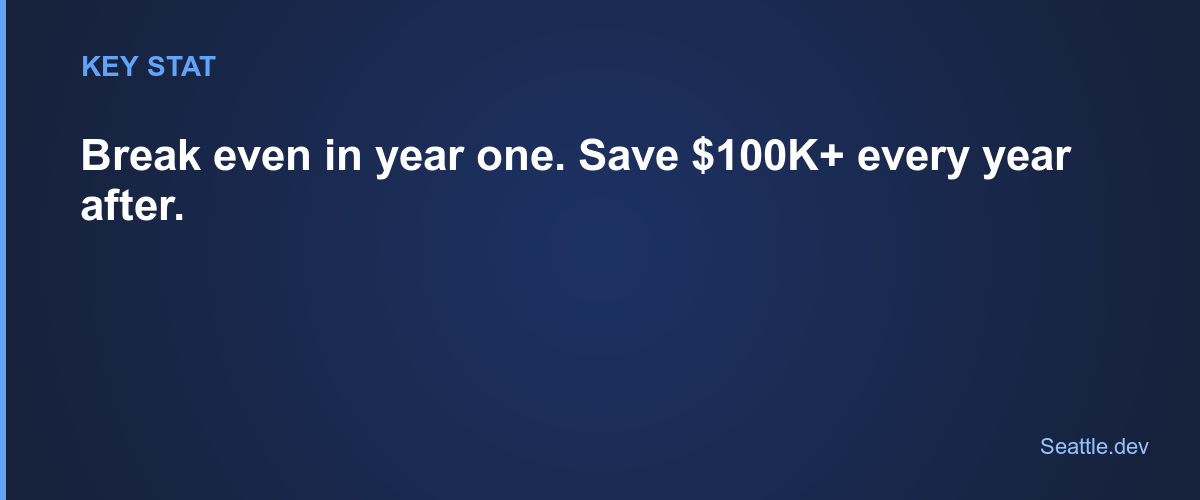
Total cost over five years becomes competitive quickly. Add development cost ($75,000 for moderate complexity), five years of maintenance (15% annually), and five years of hosting ($300/month). Total five-year cost is roughly $120,000-$140,000. Compare this to off-the-shelf platforms costing $2,000/month ($120,000 in subscriptions alone over five years) plus integration, customization, and operational inefficiency costs. Custom development often costs less over multi-year periods while delivering precisely what you need.

Quantifying the Value of Custom-Fit Capabilities

Custom development delivers capabilities that generic platforms can't, providing value beyond cost comparison. Quantifying this value justifies investment even when custom costs more.

Competitive differentiation through unique capabilities. If your business model requires workflows or customer experiences that generic platforms don't support, custom development enables your strategy while off-the-shelf forces compromise. What's the value of executing your strategy properly versus settling for "close enough"? For businesses where software capabilities drive competitive advantage, this value is enormous.

Operational efficiency from perfect-fit workflows. Generic platforms force your processes to adapt to their workflows. Custom development adapts workflows to your processes. Eliminating workarounds, manual steps, and inefficiencies saves time that multiplies across your team daily. If custom development eliminates 30 minutes of daily inefficiency per person across 20 people, that's 5,200 hours annually—worth $390,000 at $75/hour fully loaded.

Customer experience advantages. For customer-facing portals, generic solutions often look generic and feel bolted-on. Custom development creates seamless, branded experiences that build customer confidence and satisfaction. Better customer experience improves retention, increases lifetime value, and enables charging premium prices. Even small improvements in these metrics generate significant value.

Scalability without renegotiation. Many SaaS platforms charge per user, per transaction, or per API call. As your business grows, costs grow proportionally and you regularly renegotiate contracts. Custom development costs grow much more slowly with scale. Hosting increases moderately but not dramatically. Maintenance remains roughly constant. This predictability is valuable for financial planning and creates better unit economics as you scale.

Data ownership and control. Custom development gives you complete control over your data—how it's stored, who accesses it, how it's backed up, where it's hosted. Generic platforms control your data under their terms. For some businesses and compliance scenarios, this control alone justifies custom development regardless of cost.

Identifying When Custom Development Makes Sense

Not every situation justifies custom development. Understanding when to build versus buy prevents waste in both directions.

Build custom when you answer "yes" to these questions: Do you have unique workflows that generic platforms don't support well? Will you use this system for many years, making long-term costs important? Do you need specific integration with proprietary systems? Are there compliance or security requirements that SaaS platforms can't meet? Is the software core to competitive differentiation? Do you have sufficient users or usage volume that per-user or per-transaction pricing becomes expensive?

Buy off-the-shelf when you answer "yes" to these: Do standard platforms serve your needs well with minimal customization? Is time to deployment more critical than perfect fit? Do you lack internal capability to maintain custom software long-term? Will you likely need capabilities only larger platforms can provide at scale? Is your budget very limited and upfront spending impossible?

The decision isn't always binary. Hybrid approaches often work—buy generic platforms for commodity functions and build custom for differentiating capabilities. Use off-the-shelf CRM but build custom customer portals. Leverage standard financial software but create custom operational dashboards. The right mix depends on your specific situation.

Building the Business Case for Custom Development

Convincing stakeholders to invest in custom development requires clear business cases that address concerns and demonstrate value.

Frame costs properly in context. Don't just state development costs—show total five-year cost comparison including all expenses (subscriptions, integration, customization, operational inefficiency, switching costs for off-the-shelf) versus (development, maintenance, hosting for custom). This apples-to-apples comparison shows custom development is often comparable or cheaper long-term.

Quantify operational efficiency gains. Time your team currently spends on workarounds, manual processes, and fighting with inadequate tools. Calculate the annual labor cost this represents. Show how custom development eliminates these inefficiencies and calculate annual savings. This often justifies investment on efficiency alone before considering strategic value.

Demonstrate strategic value clearly. Explain capabilities custom development enables that off-the-shelf prevents. Connect these capabilities to business outcomes—customer retention, competitive differentiation, market expansion, operational scalability. Put numbers on these outcomes where possible.

Address risk concerns directly. Stakeholders worry about custom development risk—what if the developer disappears, what if requirements are wrong, what if technology becomes outdated. Address these concerns with plans for documentation, code ownership, iterative development that validates requirements progressively, and use of standard technologies with long-term viability.

Show path to value clearly. Lay out realistic timeline showing when development completes, when teams are trained, and when benefits begin accruing. Show how value compounds—initial launch delivers partial benefits, iterative improvements add more value, and efficiency gains multiply over time. This progression demonstrates that while upfront investment is significant, payback is clear and value is enduring.

Common Mistakes in Build Versus Buy Decisions

Understanding common decision-making errors helps avoid them in your own analysis.

Underestimating hidden costs of off-the-shelf. Many organizations evaluate only subscription costs without accounting for integration, customization, operational inefficiency, and lock-in expenses. This makes off-the-shelf appear cheaper than it actually is and leads to regretful commitments.

Overestimating custom development costs. Fear of expensive custom projects leads to inflated estimates that make off-the-shelf look comparatively better. Realistic custom development costs for focused applications are often lower than organizations assume, especially when compared to multi-year SaaS spending.

Ignoring operational inefficiency costs. The daily friction from using tools that don't quite fit needs creates costs that never appear in budgets but are very real. These inefficiency costs often justify custom development alone even before considering strategic benefits.

Focusing on initial costs rather than total ownership. Decisions based primarily on upfront spending favor off-the-shelf regardless of long-term costs. Five-year total cost of ownership provides more accurate comparison and often shows custom development is financially competitive or superior.

Treating all capabilities as equally important. Not every function needs custom development. Focus custom investment on differentiating capabilities and strategic functions. Use off-the-shelf for commodity needs where generic solutions work fine.

Making Your Decision with Confidence

The build versus buy decision for business portals and dashboards requires thoughtful analysis that goes beyond comparing obvious costs. Consider total cost of ownership over multiple years, account for hidden costs and operational inefficiencies, quantify strategic value, and make decisions based on your specific situation rather than generic advice.

For many businesses, custom portal development delivers better long-term value than off-the-shelf alternatives—lower total cost, capabilities precisely matched to needs, competitive differentiation, and operational efficiency that compounds over time. For others, off-the-shelf platforms provide faster time to value and sufficient capability without custom investment.

The right answer depends on your specific needs, budget, timeline, and strategic priorities. What matters is making the decision based on honest, comprehensive analysis rather than oversimplified cost comparison or fear of upfront investment.

Ready to evaluate whether custom portal development makes sense for your specific situation? Schedule a consultation to discuss your requirements, current solutions, operational challenges, and strategic goals. We'll help you understand realistic costs, timelines, and value delivery for custom development and provide honest guidance about whether custom development, off-the-shelf platforms, or hybrid approaches best serve your needs.

Ready to Start Your Project?

Let's discuss how we can help bring your ideas to life

Schedule a Free Consultation
Bandmate Footer Background
Seattle.dev Logo

Custom web development and design for Seattle businesses. We specialize in API integration, custom web portals, and business automation.