
Choosing the Right Technology Stack for Your Custom Business Software
When building custom business software, one of the first decisions involves technology: which programming language, which framework, which database, which hosting platform. These choices matter, but probably not in the ways most business owners expect.
Companies often approach technology selection with anxiety. They've heard horror stories about businesses locked into obsolete technologies. They worry about making the wrong choice and paying for it for years. They read conflicting advice online—some people swearing by one technology stack while others warn against it. The technical jargon is overwhelming. The stakes feel high.
Here's the truth: technology stack matters less than you think for most business software, but it matters differently than people expect. The specific programming language usually doesn't determine success or failure. What matters is choosing mature, well-supported technologies, matching technical decisions to your business requirements and constraints, and building with good practices regardless of the specific tools used.
Let's demystify technology selection so you can make confident decisions that serve your business rather than create regret.
What Actually Matters in Technology Selection
Focus on criteria that genuinely impact your business outcomes rather than getting lost in technical preferences.
Long-term support and stability. Business software often runs for five, ten, or even twenty years. The technology stack you choose today needs to remain supported and maintainable throughout that lifespan. Established technologies with large communities, extensive documentation, and track records of stability serve this requirement better than cutting-edge frameworks that might not exist in five years.
This doesn't mean using outdated technology. It means betting on proven platforms with demonstrated longevity. Technologies that have been around for a decade and continue to be actively developed probably aren't disappearing soon. The newest JavaScript framework that launched last month might be gone next year.
Developer availability and cost. Custom software requires ongoing maintenance, bug fixes, feature additions, and updates. That work requires developers who know your technology stack. If you choose an obscure technology, finding qualified developers becomes expensive and time-consuming. Mainstream technologies with large developer communities make hiring straightforward and competitive.
This practical consideration often outweighs technical superiority. The theoretically "best" technology that only 500 developers worldwide know serves your business worse than the "good enough" technology that thousands of developers understand. You're optimizing for business sustainability, not technical perfection.
Ecosystem and integrations. Business software rarely operates in isolation. You need to integrate with payment processors, communication platforms, business tools, and APIs. Technologies with rich ecosystems and abundant libraries make these integrations straightforward. You don't want to be writing custom code for every connection because your technology stack lacks basic integration tools.
Mature platforms have libraries for everything you're likely to need. Want to integrate with Stripe? There's a well-maintained library. Need to send emails through SendGrid? Supported. Connect to your CRM? Probably multiple options available. This ecosystem richness dramatically reduces development time and ongoing maintenance burden.
Performance characteristics that match your needs. Different technologies have different performance profiles. Some excel at handling millions of simultaneous connections; others optimize for raw computation speed. Your business requirements determine what matters. If you're building a customer portal with hundreds of users, extreme scalability isn't critical—reliability and maintainability matter more. If you're processing millions of real-time transactions, performance becomes more important.
Don't over-optimize for theoretical performance needs you'll never have. Most business software doesn't require bleeding-edge performance. Adequate performance with better maintainability serves you better than optimal performance with worse maintainability.
Security and compliance capabilities. If you handle sensitive customer data, payment information, or operate in regulated industries, security isn't optional. Some technologies and frameworks include built-in security features, established patterns for common vulnerabilities, and compliance-friendly capabilities. Others require building security from scratch, which increases risk.
Look for technologies with strong security track records, regular security updates, and comprehensive documentation about handling common security concerns. Your technology stack should make secure development easier, not harder.
Common Technology Stack Patterns
Certain technology combinations work well for typical business software needs and benefit from extensive community knowledge and resources.
The traditional web stack. Technologies like PHP, Python, Ruby, or Java for backend logic combined with PostgreSQL or MySQL for databases and React or Vue for user interfaces have powered successful businesses for decades. These stacks are well-understood, well-documented, and well-supported. Developers are abundant. Resources are comprehensive. You're not pioneering—you're building on proven foundations.
This traditional approach might not be exciting, but excitement isn't the goal. Reliability, maintainability, and sustainability are the goals. Boring technology that works reliably serves businesses better than exciting technology that creates problems.
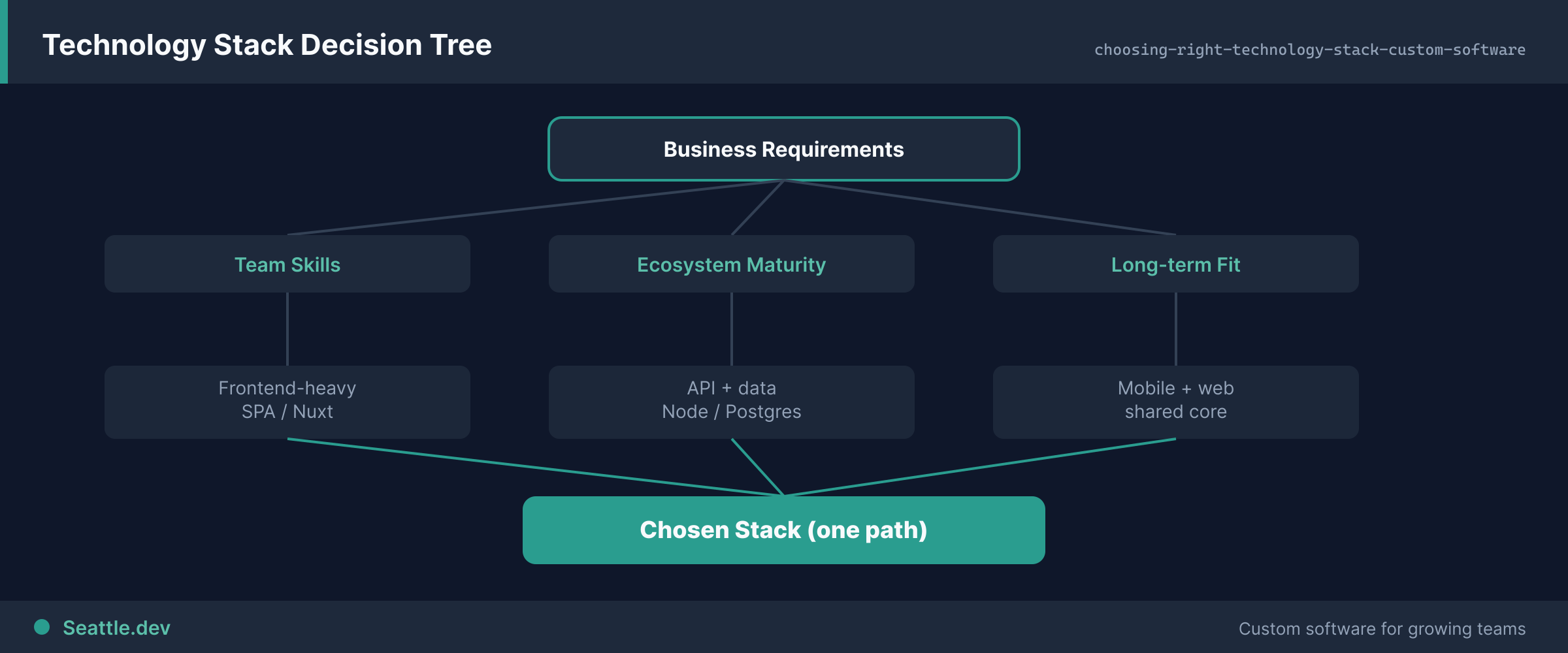
The modern full-stack framework. Frameworks like Next.js, Nuxt, Laravel, or Django provide integrated solutions that handle many concerns—routing, authentication, database access, API creation—with established patterns. These frameworks reduce decision fatigue and provide conventions that make development faster and more consistent.
Full-stack frameworks particularly benefit teams because they standardize how things are done. New developers joining the project don't need to learn custom architectures—they learn the framework, which applies to other projects as well. This standardization improves maintainability.
The API-first architecture. Building a clean API layer with technologies like Node.js, Go, or Python that serves web interfaces, mobile apps, and integrations provides flexibility. Your business logic lives in the API; different interfaces connect to it. This separation makes adding new interfaces later straightforward.
API-first design particularly suits businesses expecting multiple touch points—web portals, mobile apps, third-party integrations. The architecture accommodates growth naturally without requiring fundamental restructuring.
Technologies to Approach Carefully
Not all technologies serve long-term business software equally well. Some patterns create more problems than they solve.
The newest, trendiest frameworks. Technologies that launched recently might be exciting, but they're risky for business-critical software. Their communities are small. Best practices are still emerging. Major breaking changes happen frequently. Documentation is incomplete. Finding developers is difficult and expensive.
Let other companies pioneer new technologies. Once frameworks have been around for a few years, survived multiple versions, built substantial communities, and proven themselves in production, they become viable choices for business software.
Overly complex architectures for simple needs. Microservices, event-driven architectures, and other sophisticated patterns solve real problems at scale. But they add substantial complexity. For most business software, simpler architectures work better. Start simple and evolve architecture if real needs emerge. Don't implement enterprise-scale architecture for startup-scale problems.
Complexity is a cost. Every additional moving part is something else to maintain, monitor, debug, and understand. Simple architectures that meet your actual requirements serve you better than complex architectures that handle theoretical future requirements.
Technologies with small communities. When choosing technologies, size of community matters enormously. Large communities mean more documentation, more tutorials, more answered questions on Stack Overflow, more third-party libraries, and more developers who can help when you need assistance.
Small communities mean you're on your own more often. That undiscovered bug you encounter? You might be the first. That integration you need? You're probably building it from scratch. That deployment issue? Good luck finding answers. Community size provides insurance against problems.
Platforms that lock you in unnecessarily. Some platforms make it easy to build initially but difficult to leave later. Their proprietary approaches, specialized languages, or coupled architectures create dependencies that prevent migration. Prefer technologies that use open standards, provide data export, and don't require complete rewrites to switch later.
Lock-in isn't always bad—sometimes platform benefits outweigh flexibility costs. But understand the trade-offs explicitly rather than discovering them when you want to make changes later.
The Database Decision
Database selection deserves special attention because it's particularly expensive to change later.
Relational databases for structured business data. Most business software deals with structured, relational data—customers have orders, orders have line items, products have categories. Relational databases like PostgreSQL and MySQL excel at these relationships. They provide robust querying, enforce data integrity, handle transactions properly, and scale to substantial volumes.
Unless you have specific reasons to choose otherwise, relational databases are the safe default for business software. They're well-understood, well-supported, and appropriate for most use cases.
NoSQL databases for specific scenarios. Document databases, key-value stores, and other NoSQL options solve particular problems well. If your data is genuinely unstructured or if you need specific scaling characteristics, NoSQL might be appropriate. But for typical business applications, they often create more complexity than they solve.
Don't choose NoSQL for novelty or because it sounds modern. Choose it because your specific data characteristics or scale requirements genuinely benefit from its properties. Otherwise, relational databases serve you better.
Planning for growth without over-engineering. Your database needs to handle current data volumes plus reasonable growth. But you don't need to architect for Google-scale if you're not Google. Modern relational databases handle millions of records efficiently with proper design. You can optimize and scale when you actually need to, not preemptively.
Database performance problems usually stem from poor schema design or missing indexes rather than database technology limitations. Good design practices matter more than database selection for most performance challenges.
Hosting and Infrastructure Considerations
Where and how your software runs affects reliability, cost, and operational complexity.
Cloud platforms vs. traditional hosting. Modern cloud platforms like AWS, Google Cloud, or Azure provide comprehensive infrastructure that scales flexibly. But they're complex and can be expensive if not managed carefully. Traditional hosting with providers like DigitalOcean or Linode offers simplicity and predictable pricing but requires more manual management.
For most business software, managed hosting that handles infrastructure concerns—servers, scaling, backups, security patches—makes sense. You're building business software, not infrastructure. Let specialists handle infrastructure so you focus on business logic.
Platform-as-a-Service simplicity. Services like Heroku, Render, or Vercel handle almost all infrastructure concerns. You deploy code; they manage everything else. This simplicity comes with less control and potentially higher costs, but dramatically reduces operational burden. For many businesses, this trade-off is excellent.
PaaS platforms particularly suit small teams without dedicated operations expertise. As you grow, you might move to more hands-on infrastructure for cost or control reasons, but PaaS makes starting straightforward.
Database hosting and backups. Database reliability is critical—losing business data is catastrophic. Managed database services from cloud providers handle backups, updates, monitoring, and scaling. This reliability is worth the premium over managing databases yourself unless you have specialized database administration expertise.
Verify backup procedures work and test restoration. Backups you haven't tested aren't really backups. Regular automated backups to multiple locations protect against various failure scenarios.
Making the Final Decision
Technology selection involves balancing multiple factors based on your specific context.
Prioritize maintainability over novelty. The most important quality of your technology stack is that it remains maintainable for years. Choose technologies that will still be actively supported and well-understood when you need to make changes three years from now. Boring and reliable beats exciting and risky for business-critical software.
Match technologies to your team's expertise. If you have developers who deeply know specific technologies, that expertise is valuable. Switching to unfamiliar technologies adds learning curve overhead. However, if your team is learning regardless, learn widely-used technologies rather than niche ones.
Consider your likely technical resources. Will you have an in-house development team? Will you work with contractors? Different scenarios favor different technology choices. In-house teams might adopt more specialized technologies because knowledge is retained. Contractor-heavy models benefit from mainstream technologies because finding qualified help is easier.
Focus on business outcomes, not technical preferences. The "best" technology is whatever lets you build, maintain, and evolve your business software most effectively over time. That might not be the newest, trendiest, or most technically elegant option. It's the option that balances reliability, maintainability, cost, and capabilities for your specific situation.
Trust experienced developers to guide decisions. If you're working with experienced developers who recommend specific technologies based on your requirements, trust their expertise. They understand trade-offs better than articles or opinions online. Ask questions about why they recommend specific approaches, but resist the temptation to override technical recommendations based on incomplete information.
Living With Your Technology Choices
Technology selection isn't permanent—systems can evolve—but changes are expensive. Making thoughtful initial choices prevents regrettable situations.
The goal isn't perfect technology selection. Perfect is impossible because requirements evolve and technologies change. The goal is good-enough technology selection that serves your business well for years while remaining changeable if truly necessary.
Most technology regret comes from choosing trendy technologies that didn't last, overly complex architectures that proved unmaintainable, or niche technologies where developers were impossible to find. These problems are avoidable through conservative, pragmatic technology selection.
Ready to build custom business software with technology choices that serve you for years? We help Seattle businesses make practical technology decisions based on their specific requirements, team capabilities, and long-term needs. Schedule a consultation to discuss your software project and explore which technologies truly fit your situation. We'll help you navigate technology selection with clarity and confidence, choosing stacks that deliver value without creating regret.